Precise About Forty, Silent About the Rest
📍 Industrial-Organizational Psychology 📅 July 12, 2026 · 7 min read
A discussion post on selection ethics and personnel law taught me that the law can be exact about one boundary and completely silent about another — and that the silence is the part worth sitting with.
Not a graded assignment this time — a weekly discussion post, the kind meant to be read once and forgotten. I went back to mine anyway, because it turned out to be some of the least guarded writing I did in the entire program. No rubric, no rating scale, just a reaction to a chapter on how the law decides who gets hired, fired, and protected.
Most of what governs hiring feels like a checklist: post the job, screen the resumes, run the interviews, make the offer. The chapter underneath that checklist is not a checklist at all — it’s a patchwork of case law, statistics, and moral judgment calls that the checklist quietly papers over. Reading it in one sitting is what produced this post, and revisiting it now is what convinced me it belonged somewhere more permanent than a discussion board.
The vetting question I never resolved
Cyber-vetting — screening a candidate by what they’ve posted publicly — was the first thing I couldn’t sit comfortably with. Verbatim, from that week:
“I stand against use of cyber-vetting in the employment process, however, it may be extremely helpful in other contexts, such as when filing for a concealed carry permit or maintaining tabs on potentially dangerous individuals… I’ve often wondered what would happen if I applied for a job at Apple, Google, Facebook, or Microsoft, where their respective hiring processes are rumored to be very thorough. Is it ethical for these corporations to scrutinize my every online and offline activity if I apply for a job at one of them? Or do I have permanent protection under the terms of service?”
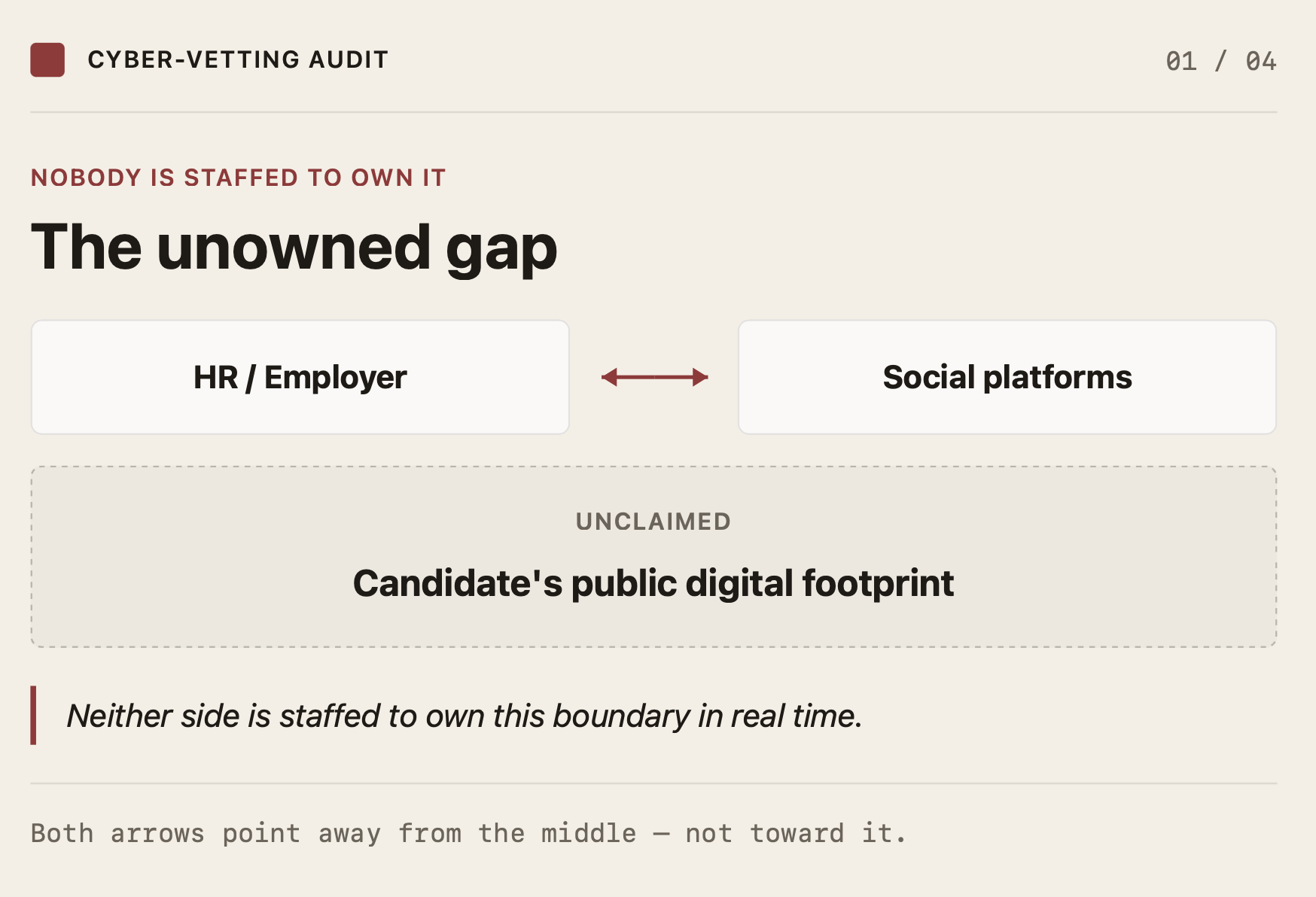
I still don’t have a clean answer to my own question. What I noticed rereading it: the discomfort isn’t really about whether cyber-vetting works — it’s about who gets to decide the boundary of a candidate’s life that’s fair game. HR departments aren’t equipped to police the internet in real time, and social platforms have shown, repeatedly, that they aren’t either. So the practice survives in a gap nobody is actually staffed to own.
Two failures that look identical and aren’t
One habit from my day job followed me straight into this reading: the instinct to stop and ask whether two things that sound the same are actually the same failure mode. That week it was disparate treatment versus disparate impact, and a Bona Fide Occupational Qualification (BFOQ) sitting in the middle of the distinction. My own note on it, cleaned up slightly:
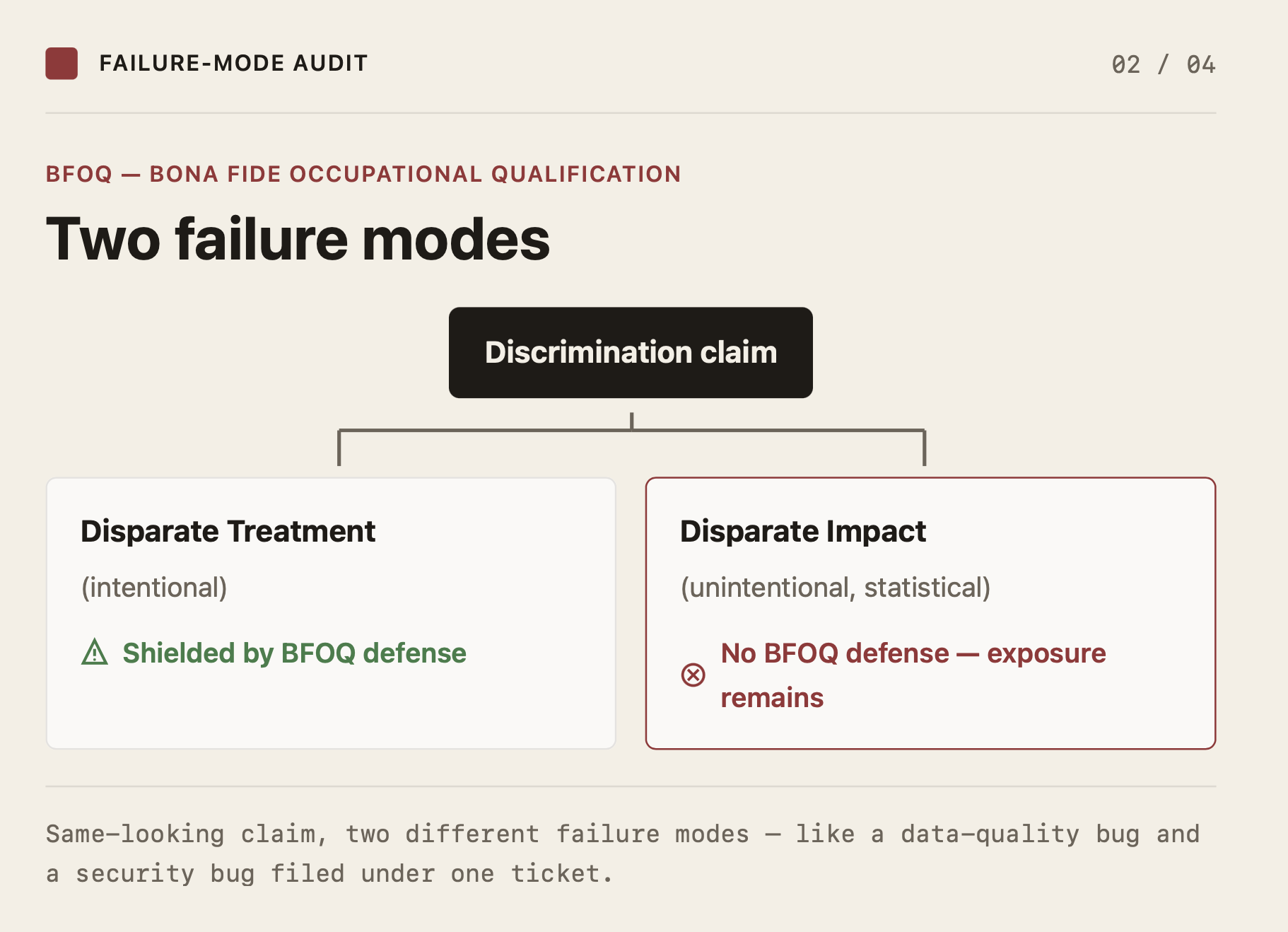
A BFOQ only applies to situations of disparate treatment, not disparate impact. Intentional discrimination is the focus of the former; unintentional bias against a minority group is the focus of the latter.
That’s a small distinction with a large consequence: a company can have a perfectly legitimate BFOQ defense against a claim of intentional discrimination and still be fully exposed on a claim of unintentional, statistical bias, because the two are answering different questions. Conflating them is the legal equivalent of treating a data-quality bug and a security bug as the same ticket because they both showed up in the same report. Different failure, different fix, different defense.
The same week gave me a cleaner example of scrutiny done right: validated selection tools for surgeons, where situational specificity and multiple cutoff scores justify a psychomotor test that would be indefensible for almost any other job. The difference between that and cyber-vetting isn’t the amount of scrutiny — it’s that one is backed by a documented, job-relevant reason and the other isn’t backed by anything except “we could.”
The line that was precise, and the line that required an argument
Then personnel law handed me the sentence that’s stayed with me longer than anything else from that chapter:
“The ADEA says that protection starts at age 40, and sexual orientation and gender identity are still not covered by federal regulations aimed at safeguarding employees’ civil rights.”
That was true when I wrote it — it stopped being true a few years later. In 2020, the Supreme Court ruled in Bostock v. Clayton County that Title VII’s ban on sex discrimination necessarily covers sexual orientation and gender identity, closing exactly the gap I was writing about. I’m keeping the line verbatim anyway, because the contrast underneath it is more interesting than the fact itself once you update it.
Read the two protections side by side. Age discrimination got a precise number — not “middle-aged,” not “older workers,” the exact integer 40 — written directly into the statute in 1967, settled from day one. Sexual orientation and gender identity got their protection too, eventually, but through a completely different route: decades of litigation, case after case arguing that the word “sex” already in Title VII had always meant this, until a court finally agreed. One protection was legislated into precision. The other had to be argued into it.
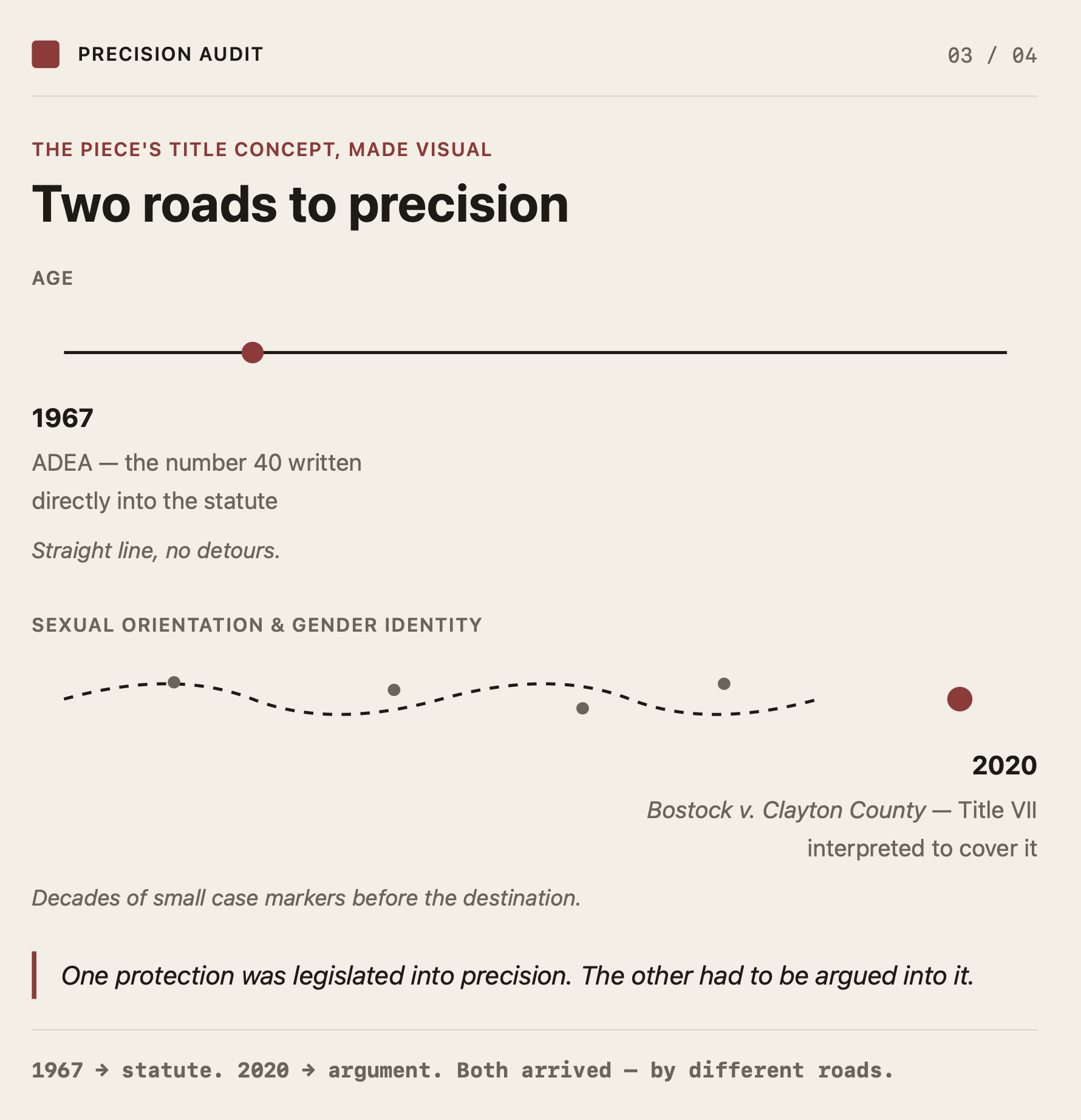
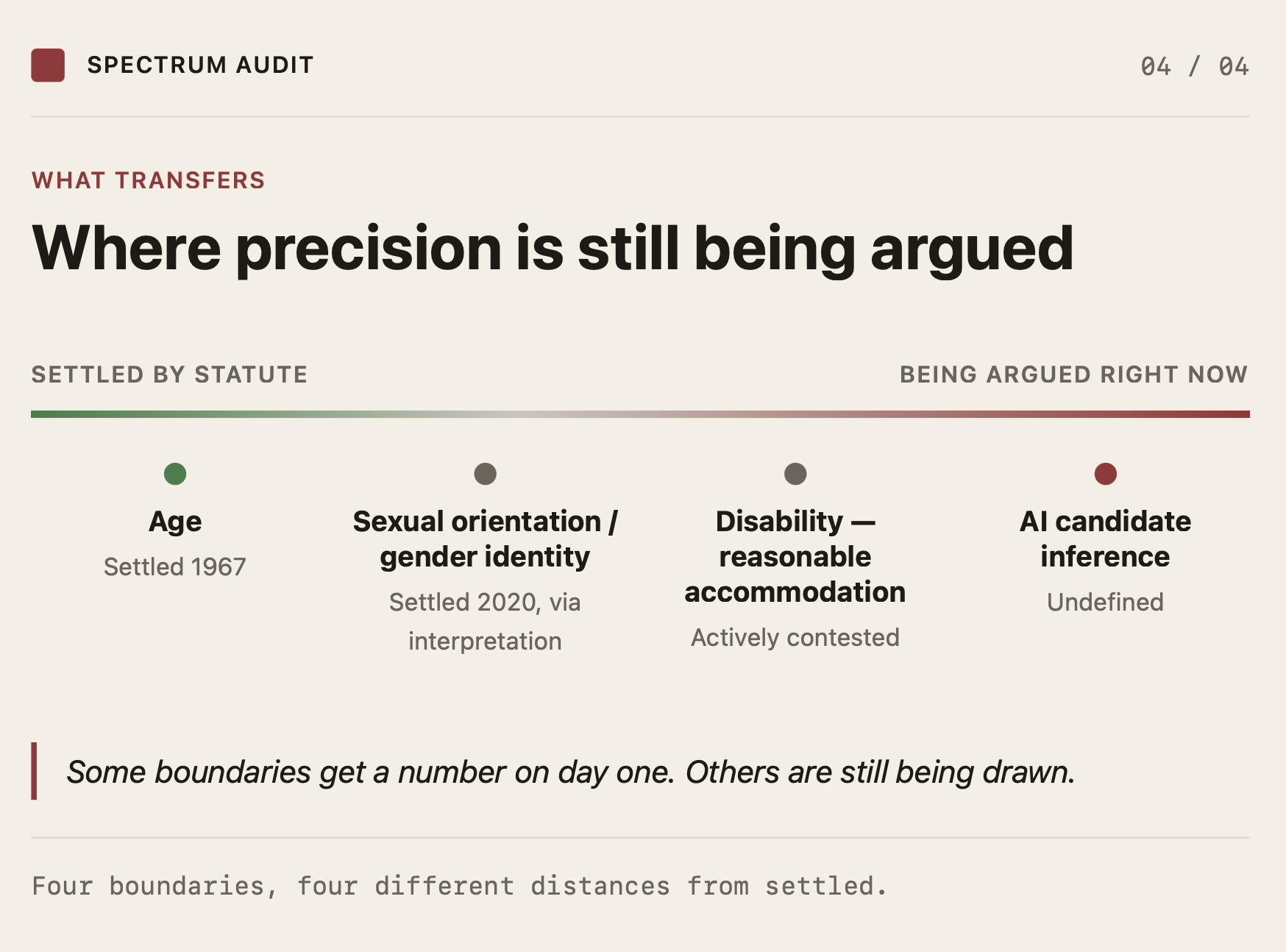
I don’t think the lesson here is that age protection is over-specified. It’s that precision arrives by different roads, and which road a protection takes tells you something about how contested it was. The same pattern shows up in disability law, where “reasonable accommodation” and “undue hardship” are still being renegotiated in real time as our understanding of disability shifts from a purely medical definition toward a social and political one — precision still being argued into existence, in real time, on a different boundary. Some protections get a number on day one. Others get a decades-long argument first. Neither is an accident, and neither tells you the argument is over.
What transfers
I’d already started making a version of this argument about AI in hiring before I fully had the words for it — the idea that “a technology is only a mirror of its creators, including their functions and hierarchy,” and that present biases don’t disappear inside an algorithm, they just get harder to see. That instinct eventually became its own piece. This discussion post was the rough draft of that thought, written before I knew it was one.
My throughline is negotiating for clarity, and this chapter is where I learned that clarity isn’t evenly distributed by default — it’s granted, one boundary at a time, to whichever category the law got around to defining first, by whichever route was available: a number on day one, or an argument that took decades. Cyber-vetting persists because nobody was assigned to own the boundary. BFOQs persist because two different failures got treated as one. And entire categories of people still wait for the kind of precision age discrimination got in 1967, watching the boundaries of disability, or of what a technology should be allowed to infer about a candidate, get argued into existence one case at a time.
Thanks for reading. What’s a boundary you assumed the law had already drawn clearly — until you actually went and read the statute?
Comments