Persuasive Speech: Outline & Self-Evaluation
📍 1 Story Street, Cambridge, MA 📅 June 25, 2026 · 3 min read
We are surrounded by persuasion. For some of us, it is an everyday tool that allows us to protect our mental space and advocate for our ideas, priorities, and former and future selves. Recently, I delivered a persuasive speech for an assignment in my coursework, and the experience redefined how I view my own voice.
The persuasive speech is a 7-8 minute speech that is geared toward changing your audience’s thoughts, feeling, ideas or actions about a particular subject. This speech must be given extemporaneously using an outline in the proper format. If the speech is memorized, written out, or read you will receive a failing grade.
The course required two speeches: an Informative Speech and a Persuasive Speech. My experience delivering the informative speech (Topic: Non-code contributors in the IT industry) taught me that I needed three things to earn a higher grade on the succeeding assignment:
- Put more trust and effort in my outline
- Stay conscious of my pacing
- Connect more intentionally with the audience
When I started preparing for the Persuasive speech, my initial topic (Topic: Proximity, Privilege, and Cultural Awareness on long distance public bus transportation) was rejected because…
we steer away from topics that may be potentially triggering or politically charged. Systematic, or systemic, inequality falls under this umbrella.
We all want to pick up topics that give us that ‘fire in the belly’ where our passion and persuasion meet. After needing to find a new direction, I landed on a topic I was passionate about that was also safe for the audience. I then had to choose which speech outline pattern to use. While I chose the Topical pattern for my informative speech, I decided to use Monroe’s Motivated Sequence to curate the outline for my persuasive speech.
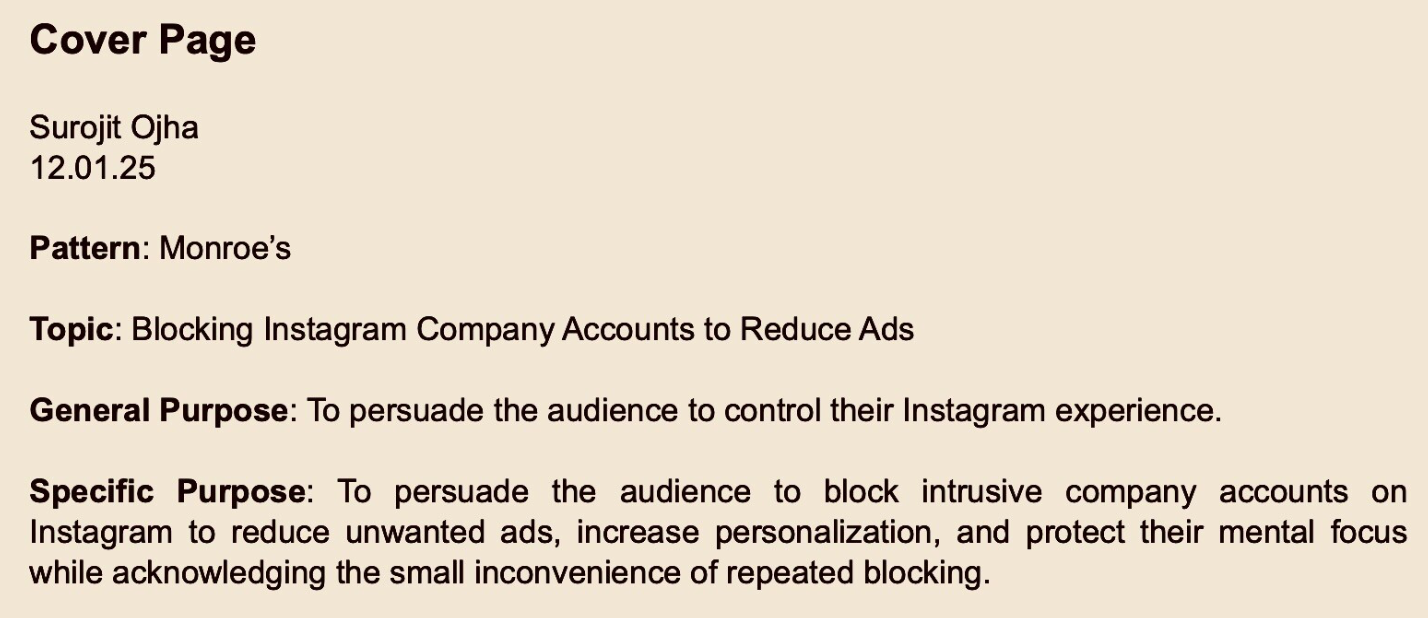
Monroe’s Motivated Sequence requires the speech to have five sections:
- Attention
- Need
- Satisfaction
- Visualization
- Call to Action
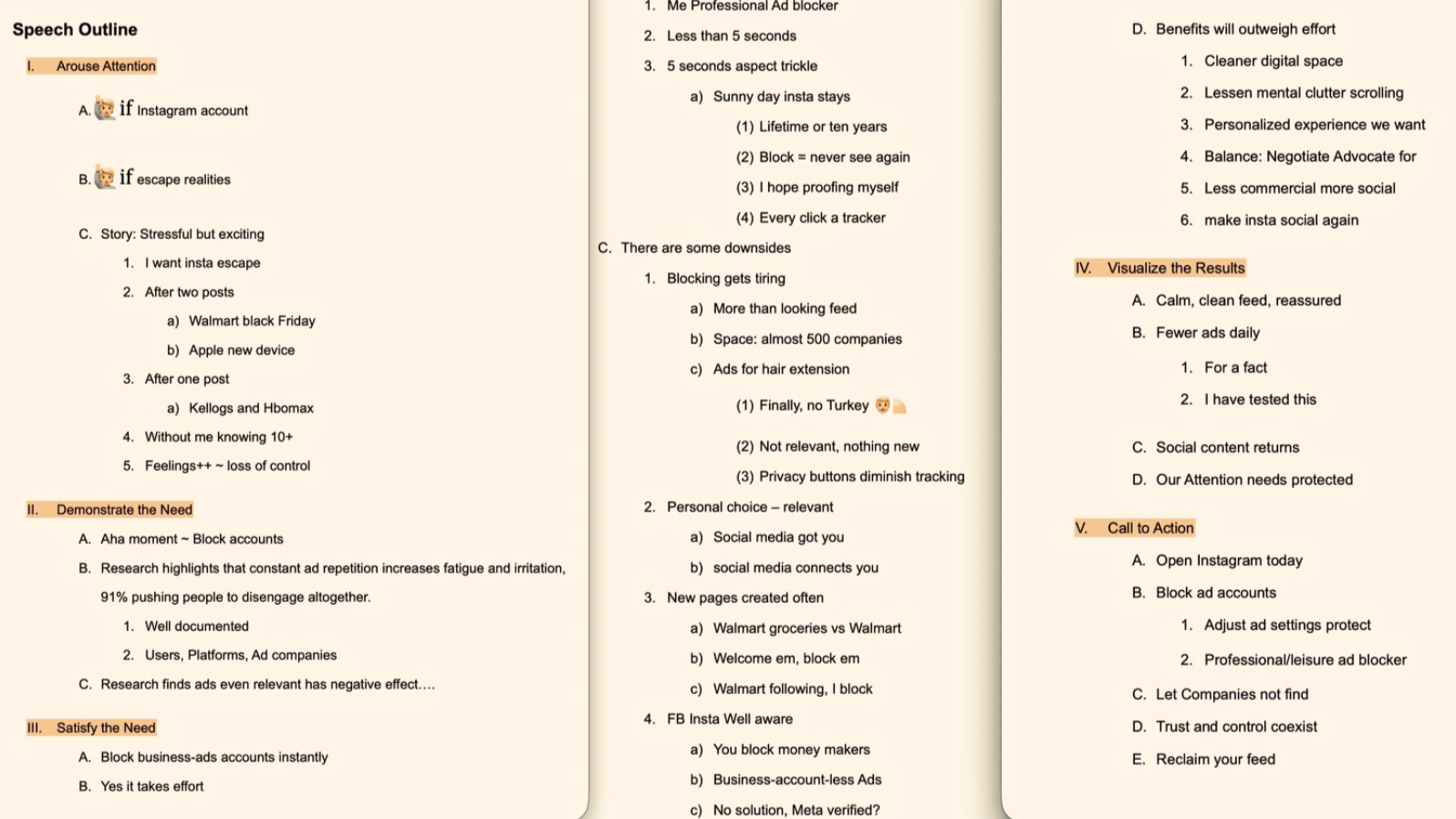
I stayed with these sections for a few days, and by putting more time, energy, and thought into them allowed me to create a reasoning structure that included Aristotle’s three appeals for persuasion: Logos, Ethos, and Pathos.
I practiced my speech a total of five times: twice with my husband, twice with my speech buddy, and once with my dear friend Mr. Q. My goal was to avoid over rehearsing so the delivery would not appear/become memorized or mechanical. The outline contained four words or less per line (except for specific statistics) so that I could only glance at it when needed to maintain the flow of my intended thoughts.
Persuasive Speech ‘Speaking Outline’
As soon as you finish your speech, hand the outline that you used during the speech to the instructor.
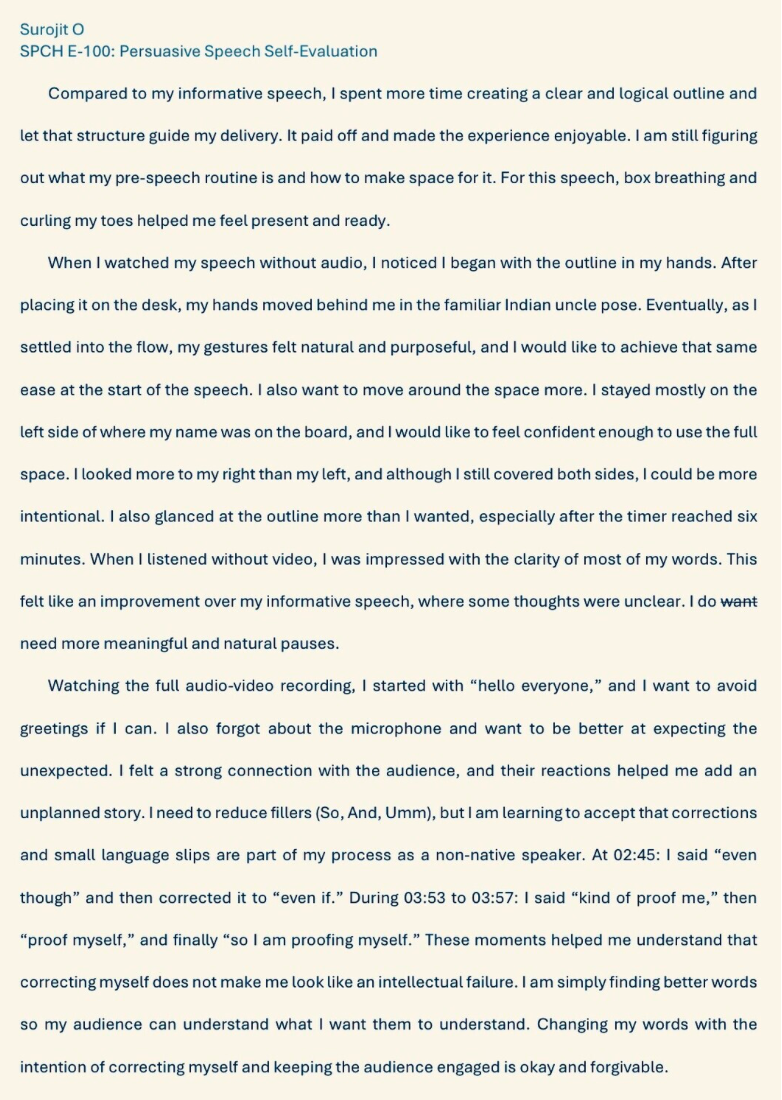
One day later, I received the recording, which allowed me to relive and reflect on my speech delivery. My biggest takeaway as a non-native English speaker was the realization that my mid-speech corrections were actually a way to negotiate for clarity and ensure my audience understood my intent.
Persuasive Speech Self Evaluation
You are required to view your speech and submit a 250-300 word self-evaluation noting your strengths and areas for improvement to work on for your next speech.
Thank you for your time and I hope my experiences help open you to your own persuasive speech skill delivery.
Comments