My Power Audit: What I Found When I Examined My Own Influence at Work
📍 Organizational Behavior 📅 June 27, 2026 · 3 min read
A one-page assignment asked me to audit my workplace power. What I found was mostly a map of my own anxiety.
What follows is my reflection on a power audit assignment from my coursework. These are honest observations from my own professional experience — shared because I think more people should do this audit, and then talk about what they find.
My professor once gave me an assignment that made me uncomfortable in exactly the right way.
Reflect on your current level of power within your organization. Then identify what opportunities you have to develop it further.
One page. Double-spaced. I had been in a technical operations leadership role for several years. I assumed this would be straightforward. I was wrong.
What I Found
The assignment asked me to assess my top ten workplace relationships — to honestly evaluate how much I gave versus how much I took from each one.
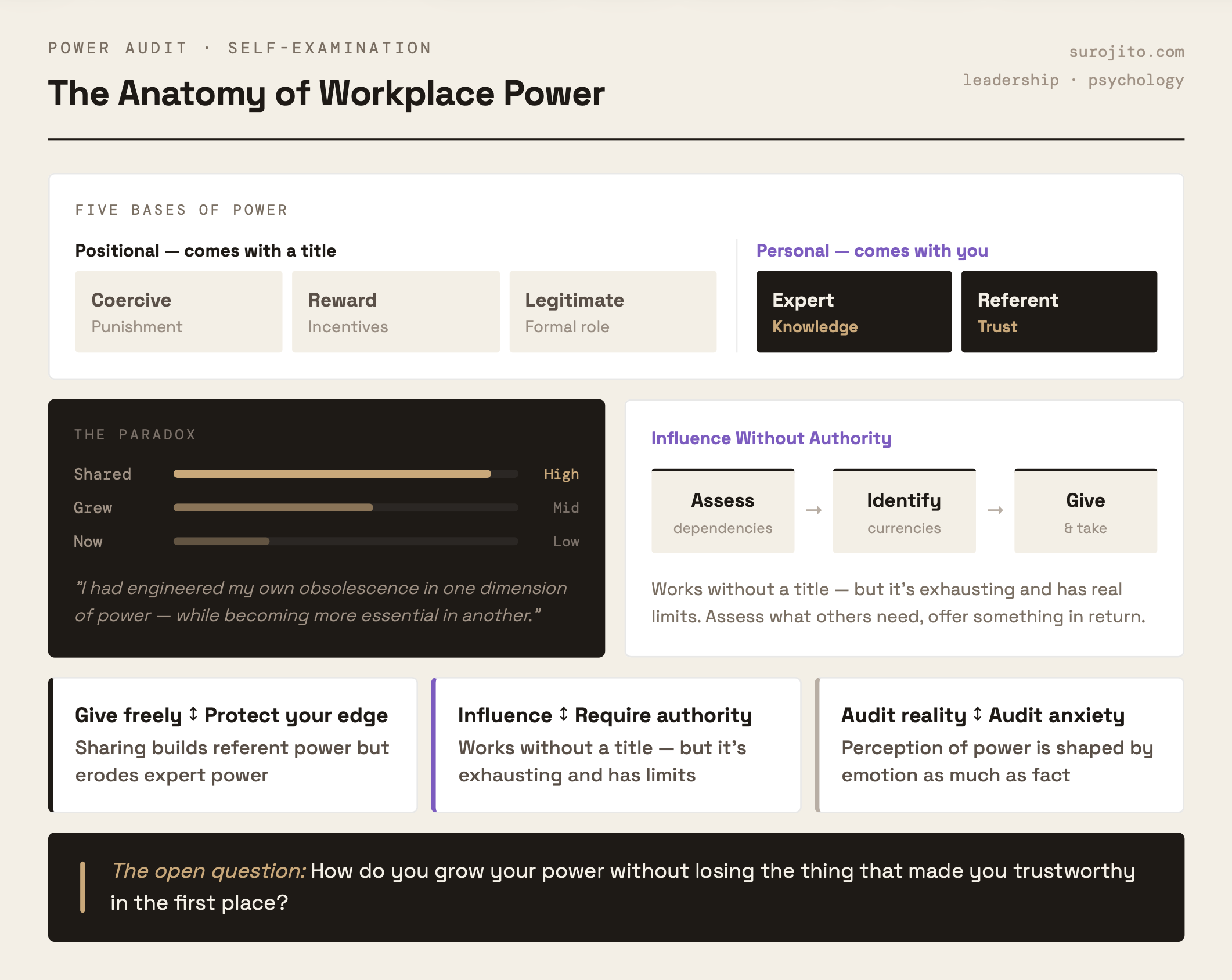
What I found surprised me. I perceived almost all of those relationships as holding legitimate power over me. That was not accurate — but it was true to how I felt. The intensity of a task, the newness of a request, how quickly I had to respond — all of it colored my perception of where power actually lived. I was not auditing reality. I was auditing my anxiety.
I also found something harder to sit with: my expert power had diminished. Not because I had stopped learning. But because I had spent years freely sharing everything I knew — documentation, frameworks, processes, institutional knowledge — with anyone who asked. Colleagues who had once come to me for everything had grown. They caught up. Some surpassed me.
I had, without fully realizing it, engineered my own obsolescence in one dimension of power — while becoming more essential in another.
The relationships I found hardest were the constrained ones. The ones where information was hoarded, where getting a straight answer required three follow-ups, where I walked away from a conversation more drained than when I entered it. I wrote this at the time: “Those relationships that are harder to extract information from are particularly emotionally exhausting.”
What I’m Proud Of
I wrote in that assignment: “I am proud of modeling good organizational citizenship.”
I still am. Even when it cost me expert power. Even when most people did not engage with the resources I published. Even when I carried invisible labor that never appeared in a job description.
I kept giving because I believe that is how trust is built — not hoarded.
What I’m Doing Next
The audit taught me that influence without positional authority has real limits. You can build systems, coach colleagues, and create frameworks others depend on — but shared ownership requires structural support, not just individual effort.
So the question the assignment left me with is the one I keep returning to: how do you grow your power without losing the thing that made you trustworthy in the first place?
I do not have a clean answer. But I have stopped waiting for one to arrive on its own.
The audit is not a one-time assignment. It is something you have to keep doing — and then act on.
Power does not recognize itself. You have to name it. And then you have to negotiate for it.
Comments