Looking Inward: What a BuzzFeed Quiz Taught Me About Myself
📍 Power and Privilege in Systems 📅 June 28, 2026 · 7 min read
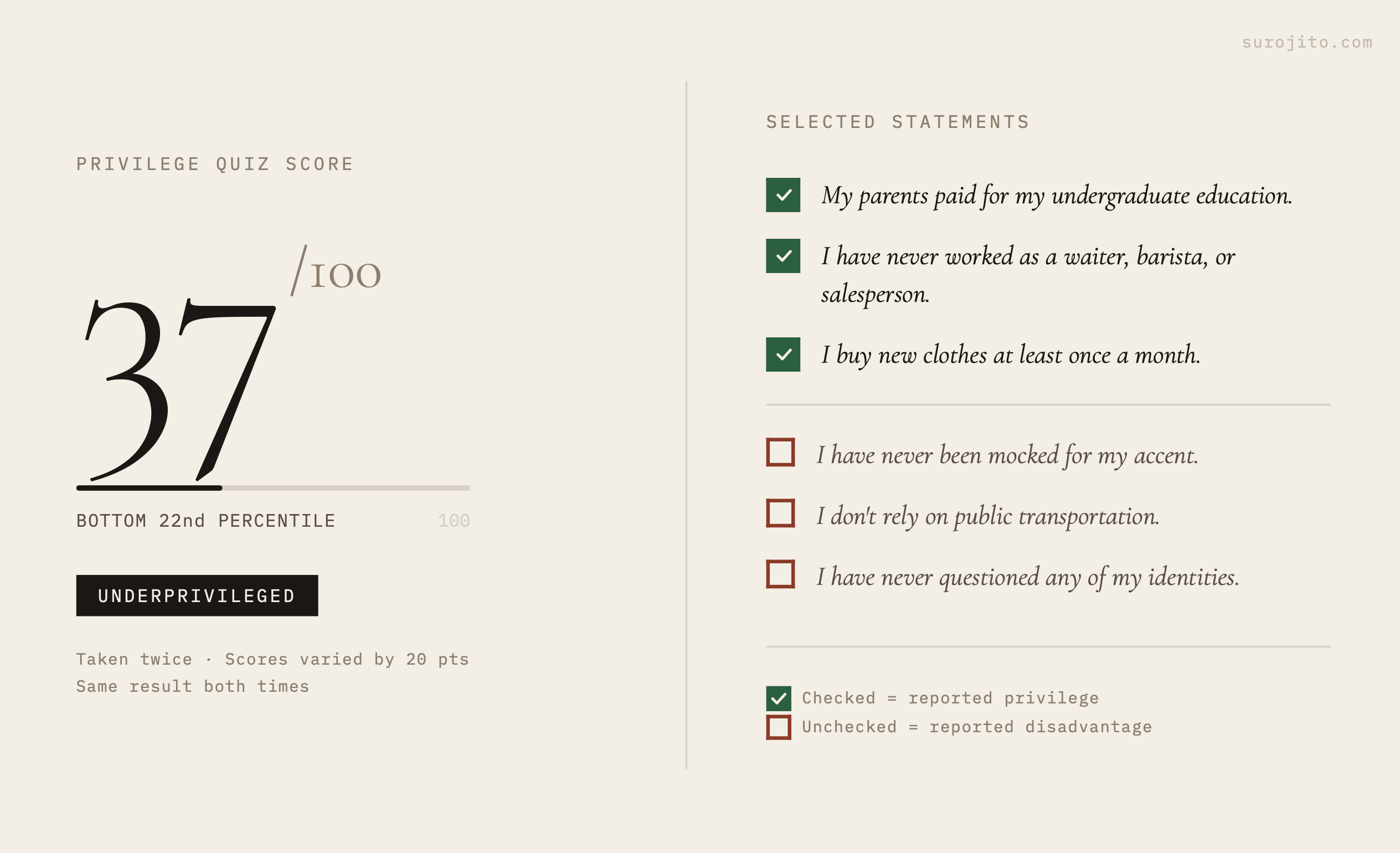
My professor assigned us a BuzzFeed quiz. I took it twice. I got 'underprivileged' twice. Here is what I found when I stopped pretending otherwise.
What follows is my reflection on a privilege and identity assignment. These are honest observations from my own life — shared because looking inward is harder than it sounds, and because I think more people should try it.
My Harvard professor assigned us a BuzzFeed quiz.
I was excited to know something like this existed. And then I started reading the questions. The quiz asks you to check off statements like “I have never been mocked for my accent” and “I buy new clothes at least once a month” as if they carry equal weight. They do not. The sense of disadvantage in “I have never feared for my physical safety” is not the same as “I don’t know how to cook.” The binary format — yes or no, checked or unchecked — collapses the time, context, and nuance that shape who we actually are.
And yet.
I took it twice, with varying degrees of honesty and fatigue. My scores differed by 20 points. Both times, the result was the same: “You’re underprivileged.”
37 out of 100. Bottom 22% of all quiz-takers.
I sat with that for a while.
The Ideal Gas I Was Pretending to Be
In chemistry, students spend half a semester learning the ideal gas law before being told: there is no such thing as an ideal gas. All gases deviate from the ideal. The ideal is a useful fiction — a reference point, not a reality.
It has taken me ten years of living in the United States to stop being the ideal gas version of myself.
What I mean is this: people with disadvantaged identities sometimes construct an ideal version of themselves in their minds — a version with no complicated histories, no difficult questions, no labels. They adopt cleaner stories. They distance themselves from the parts of their identity that feel like liabilities. And sometimes, quietly, they begin to resent the people who don't — the ones who hold onto their true, complicated, disadvantaged selves without apology.
I did this. I understand now why I did it. And I understand now why it was costing me something.
You cannot study power and privilege honestly if you are not honest with yourself first.
What I Found When I Looked
The quiz struck a nerve in unexpected places.
My parents paid for my undergraduate education. That single fact — which I had never thought of as privilege, just as “how things were” — gave me direct entry into the professional middle class. I arrived in America not at zero, but ahead of zero. That is not nothing. That is, in fact, a great deal.
I have never worked as a waiter, a barista, a bartender, or a salesperson. I did not know, until the quiz asked me, that this was a form of privilege. I had simply never needed to. The absence of an experience can be as revealing as the experience itself.
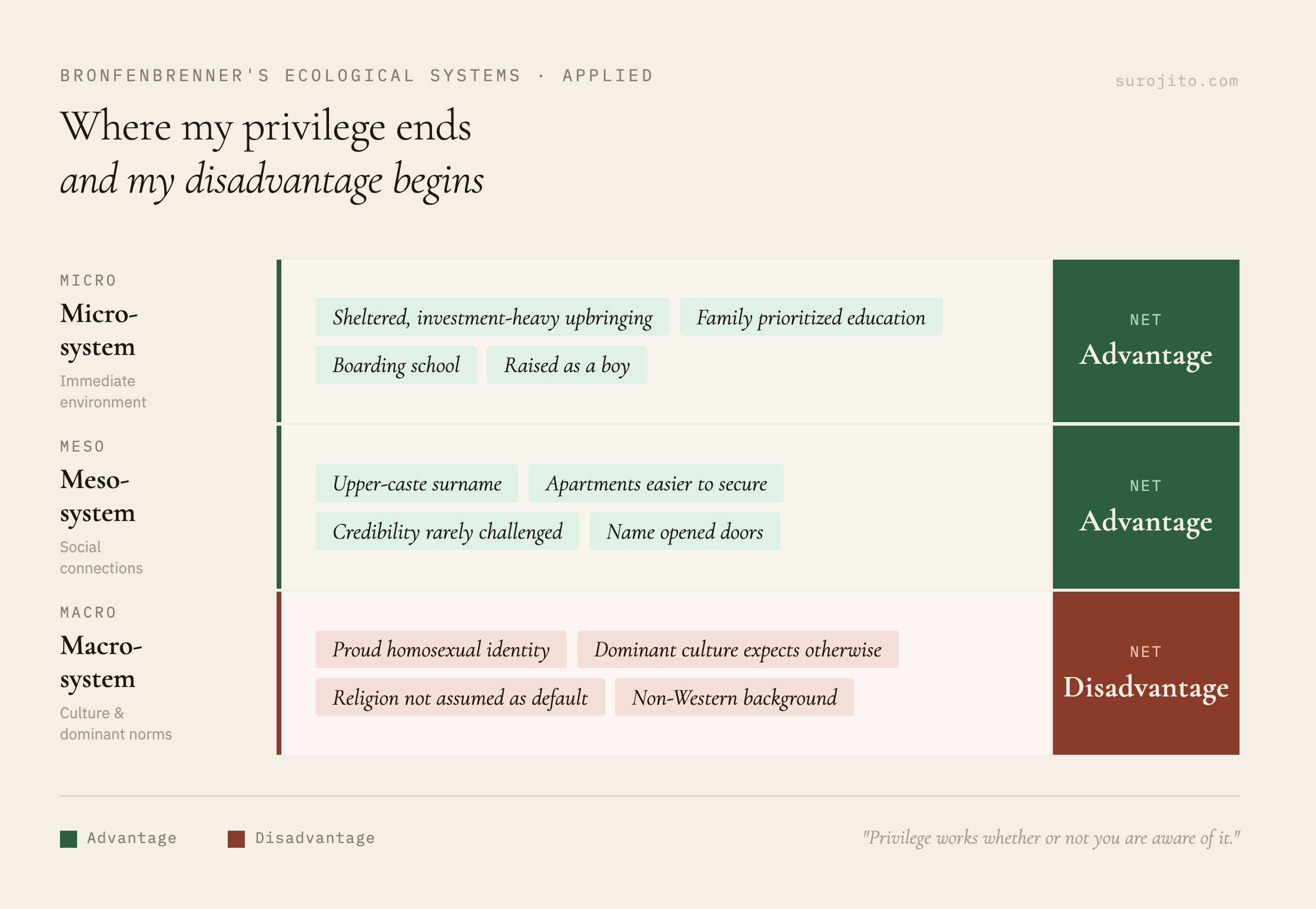
When I applied Bronfenbrenner’s ecological systems theory to my own life, the picture became even clearer — and more complicated.
The microsystem of my early years was sheltered and investment-heavy. My family prioritized my education. I grew up in a city, attended a boarding school, and was raised as a boy in a context where those things compounded into advantage.
The mesosystem reinforced this. I carry a surname that signals upper-caste identity in India. I did not know, for most of my life, what that meant in practice — until I traveled across the country and noticed, slowly, unmistakably, that I moved through spaces differently than others did. Apartments were easier to secure. My credibility was rarely challenged. My name opened doors I could not see until I started looking for them.
The macrosystem is where I started losing ground. Being a proud homosexual does not align with mainstream social expectations in most of the places I have lived. That tension — between who I am and what the dominant culture expects — is where my privilege ends and my disadvantage begins.
The Obama Moment
When I first arrived in the United States, I could not understand why President Obama kept saying “God bless America.” It seemed strange to me, almost provincial. I came from a tradition of many gods, many goddesses, many ways of invoking grace.
After a decade, I understood.
He was speaking to a nation whose dominant groups are White and Christian. “God bless America” lands softly for people whose god is assumed to be the default. Just as “May gods and goddesses bless America” would land softly for me, and strangely for them.
Dominant groups — in any system — tend to support structures that reinforce existing hierarchies, often without awareness that they are doing so. This is what Social Dominance Orientation describes: the degree to which people prefer their group to be on top, and how that preference shapes what they see as natural, fair, or simply normal.
I have been, at various points in my life, both dominant and not. Both seen and unseen. I continue to benefit from systems of gender, caste, and class even when I am not thinking about them. That is the nature of privilege: it works whether or not you are aware of it.
What the Quiz Actually Is
The BuzzFeed quiz is not a rigorous instrument. It is unscientific, unweighted, and blunt. A psychometrically sound version — one calibrated to specific ecological systems, specific marginalized groups, specific contexts — would be far more powerful.
But that is not what the quiz is for.
The quiz is for starting the conversation. For cracking open the question you have been avoiding. For making visible the thing you have been navigating by feel — the accumulated weight of what you were given, what you were denied, and what you never knew to ask for.
I took it twice. I got “underprivileged” twice.
And here is what I think that means: I grew up with an intersectional, complicated identity — one that handed me advantages I did not see and disadvantages I could not escape. Life did not let me forget it. I just spent a long time pretending otherwise.
Looking Inward as a Practice
My mother once explained to me why a god in our religion has an elephant head. She told it as a story — layered, mythological, full of meaning that had accumulated over centuries. The explanation required patience and openness. It could not be compressed into a checkbox.
People are like this. Our identities and histories carry weight that cannot be captured in binary formats. This is true for the quiz, and it is true for how we see each other at work, in communities, in classrooms.
The realities of my intersectional identities continue to evolve. I am still unpacking privileges I received decades ago. I am still coming to terms with the parts of myself I hid for years.
But I am looking inward now. Honestly. Without the comfortable fiction of the ideal gas.
That, I think, is where it starts.
Have you ever taken a quiz or done an exercise that surprised you with what it revealed about your own identity? I’d love to know what looking inward has taught you.
Comments