Gender & Competitiveness: Not More. Not Less. Just Different.
📍 Peak-Performance Psychology 📅 June 26, 2026 · 4 min read

A weekly reading prompt on trait competitiveness pushed me to question a claim I'd always taken for granted.
What follows are my personal responses to weekly reading prompts from my coursework, shaped by the research papers I’ve been working through. These are generalized views and reflections — not clinical claims — and I’m sharing them because I think the findings are worth a wider conversation.
We’ve all heard it said, casually, confidently: “Men are just more competitive.” It’s one of those statements that floats around workplaces, dinner tables, and boardrooms as though it were settled science. After working through the research this week, I’d push back on that — carefully.
Do I think there are gender differences in trait competitiveness?
Yes — but not in the way most people mean it.
Females are frequently pitted against each other from an early age. Rather than purely driving them to “win,” this experience tends to build something more nuanced: a heightened self-awareness and an early understanding that societal judgments are shaped by bias rather than fair comparison. That exposure helps women develop a skill for discerning which competitions are genuinely worth entering — and which ones simply reinforce expectations placed on them by others.
At the same time, females often navigate success through deliberate thought and considered decisions, while males tend to assert their position through visible action — or strategic inaction. That “action-oriented” style makes men appear more competitive, an image reinforced everywhere from sports coverage to action films, where competition is tied to direct, outward assertiveness.
In sports specifically, male athletes receive disproportionate sponsorship, media coverage, and public recognition. Males are also culturally encouraged to embrace risk-taking as part of their identity. For women, that same risk-taking orientation often goes unaddressed — which, over time, may quietly shape how they see themselves as competitive actors.
Would I agree that men are inherently more competitive than women?
No — not fully.
The research draws a meaningful distinction: men tend toward dominant competition, aiming to outperform and outrank. Women more often compete for self-improvement or within collaborative frameworks. But here is the part that deserves more attention — context matters enormously. Women compete just as intensely when the rewards are meaningful, when the outcome benefits others, or when the framing of competition shifts away from zero-sum dominance.
Socialization explains a lot of the perceived gap. Boys are exposed to competitive environments — organized sports, rankings, direct contests — and come to associate asserting dominance with success. Women, meanwhile, are often pitted against each other in quieter, more social ways. That experience builds something different: a sharper internal sense of which competitions are genuinely worth entering, and which ones simply aren’t. That selectivity is often misread as lack of drive.
Confidence and risk tolerance also play a role. Men tend to enter competitive environments more readily, in part because they’ve been socialized to see themselves as contenders. Yet the research is clear: when women do compete, their performance and behavior closely mirror men’s.
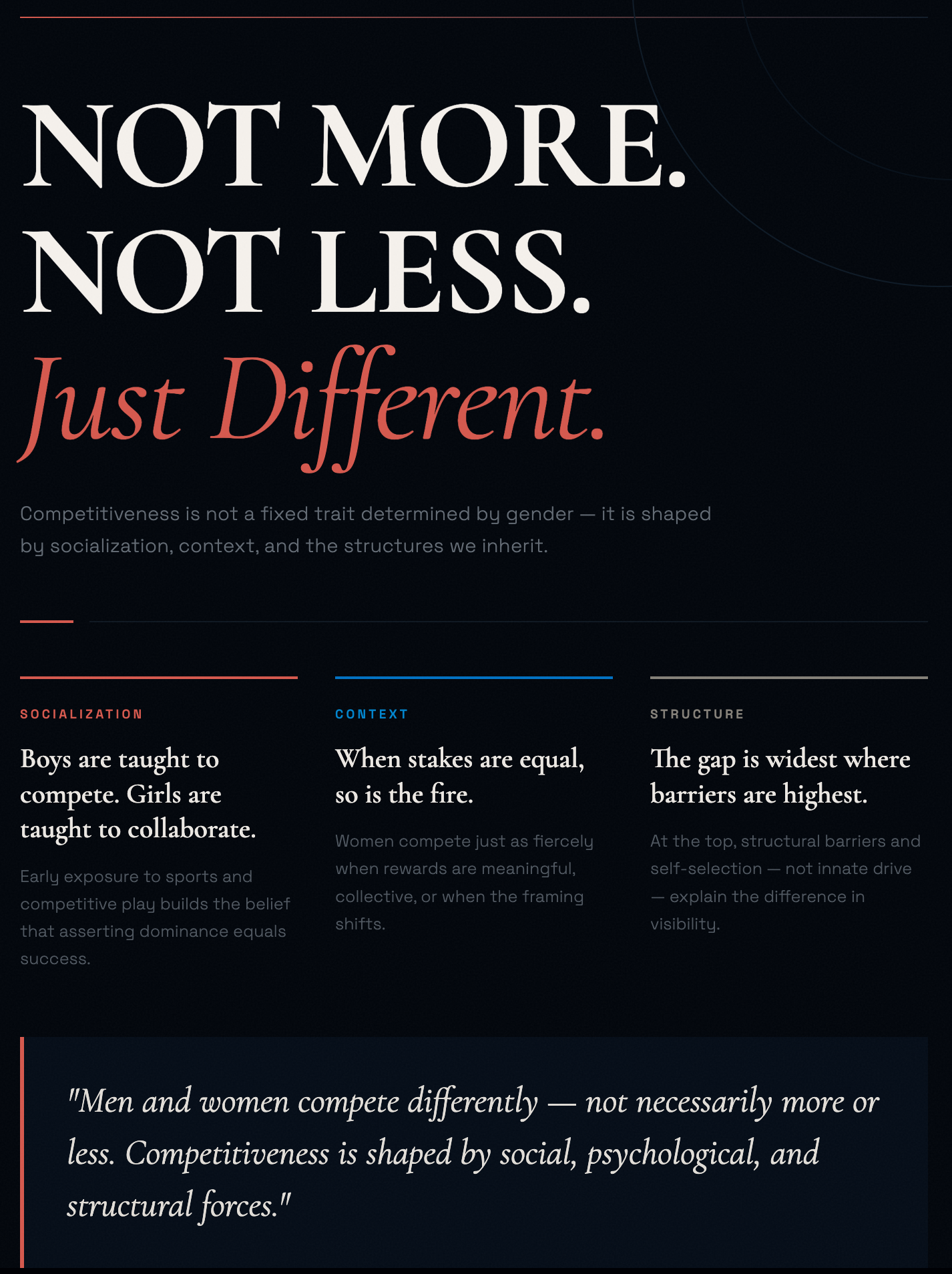
The gender gap in competitiveness is most visible at the highest levels — elite sports, executive leadership, high-stakes domains. And even there, the evidence points to structural barriers and self-selection effects as the primary drivers, not innate differences in drive. In moderate settings, the gap shrinks significantly or disappears.
The conclusion I keep arriving at: competitiveness is not a fixed trait determined by gender. It is shaped by socialization, context, confidence, and the structures we grow up inside of. Men and women compete differently — not more or less.
These reflections come from my weekly reading in my coursework. The papers have genuinely shifted how I think about competition in professional settings too. Have you seen this play out differently in your own experience — either growing up or at work? I’d be curious to hear your perspective.
Comments