Exploring Psychopathology: Days of Wine and Roses (1962)
📍 Psychopathology 📅 June 30, 2026 · 7 min read
A film assignment taught me that addiction is rarely a single event — it's the cumulative result of pressure, pain, and lost connection.
We tend to think of addiction as a moment — a first drink, a bad year, a character flaw finally catching up. Days of Wine and Roses quietly argues otherwise. Addiction, in this film, does not arrive as a problem. It arrives as a solution.
As part of a psychopathology course, I was asked to select a film portraying a psychological disorder with clinical accuracy, analyze the characters through a diagnostic lens, and reflect on what the film gets right — and wrong — about how mental illness actually works.
Select a film that portrays a character with a psychological disorder. Provide a synopsis, apply diagnostic criteria from the DSM, discuss etiology and treatment, and evaluate the film’s clinical accuracy.
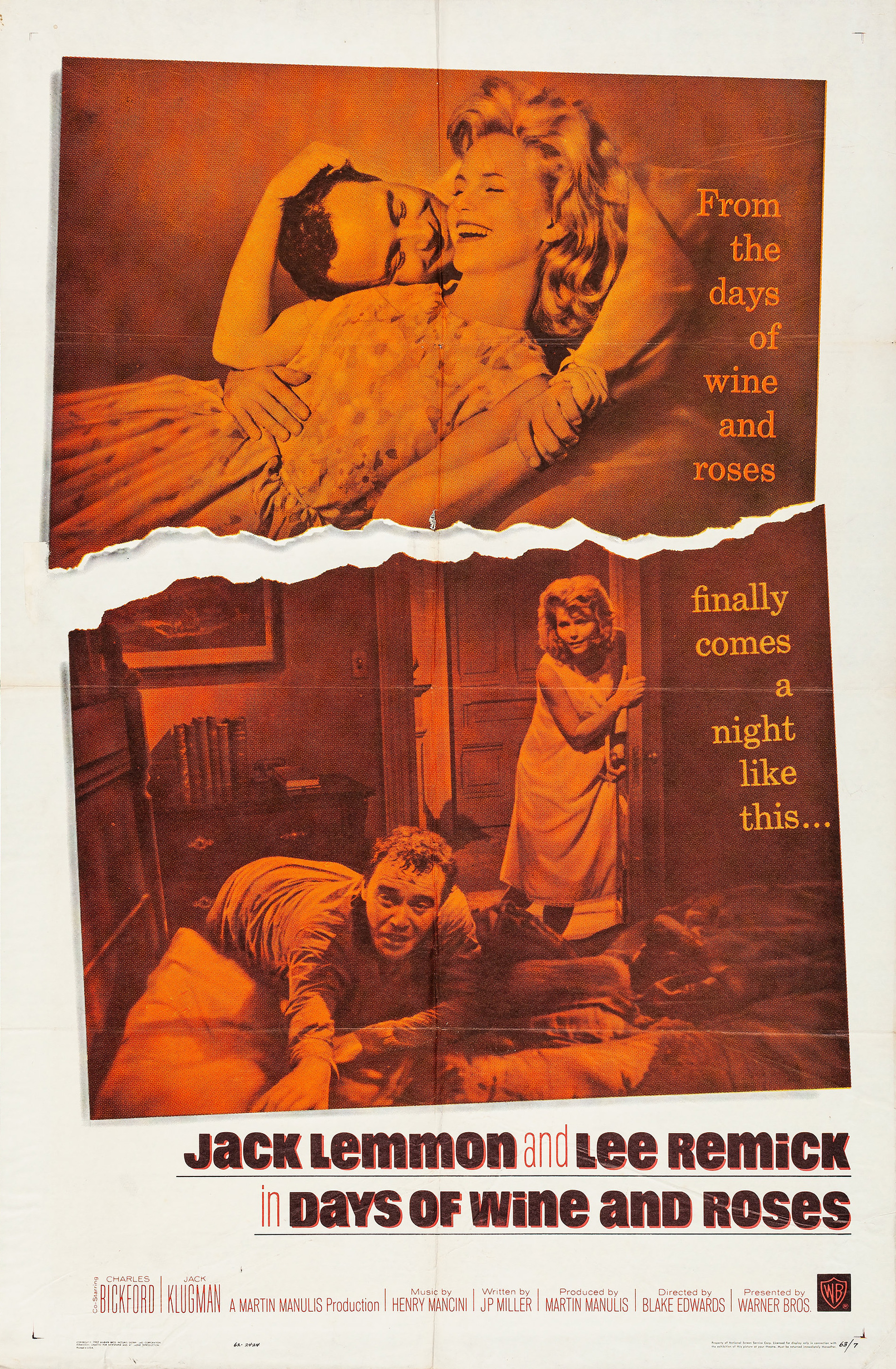
I chose Days of Wine and Roses (Edwards, 1962) for what I think of as its elliptical structure: two foci, one relationship. Most addiction narratives follow a single subject downward. This one follows a married couple — Joe and Kirsten — who fall together but surface in different directions. That asymmetry is where the real clinical story lives.
An Ellipse, Not a Line
Joe Clay is a charismatic public relations professional who already knows what he wants to avoid in life. Kirsten Arnesen is reserved, quietly ambitious, proud of a set of books her father gave her — a detail that tells you she is someone who believes in the slow accumulation of better things. She is, at first, alcohol-naive.
Their drinking begins as intimacy. It becomes a source of connection and shared identity — a private language that makes closeness feel possible without the difficulty of real vulnerability. They marry, have a daughter, and when Kirsten considers quitting to nurse their baby, Joe persuades her to use formula and keep drinking with him, as a way to preserve that closeness. It is a small, devastating choice. The film never announces it as a turning point. It just moves on.
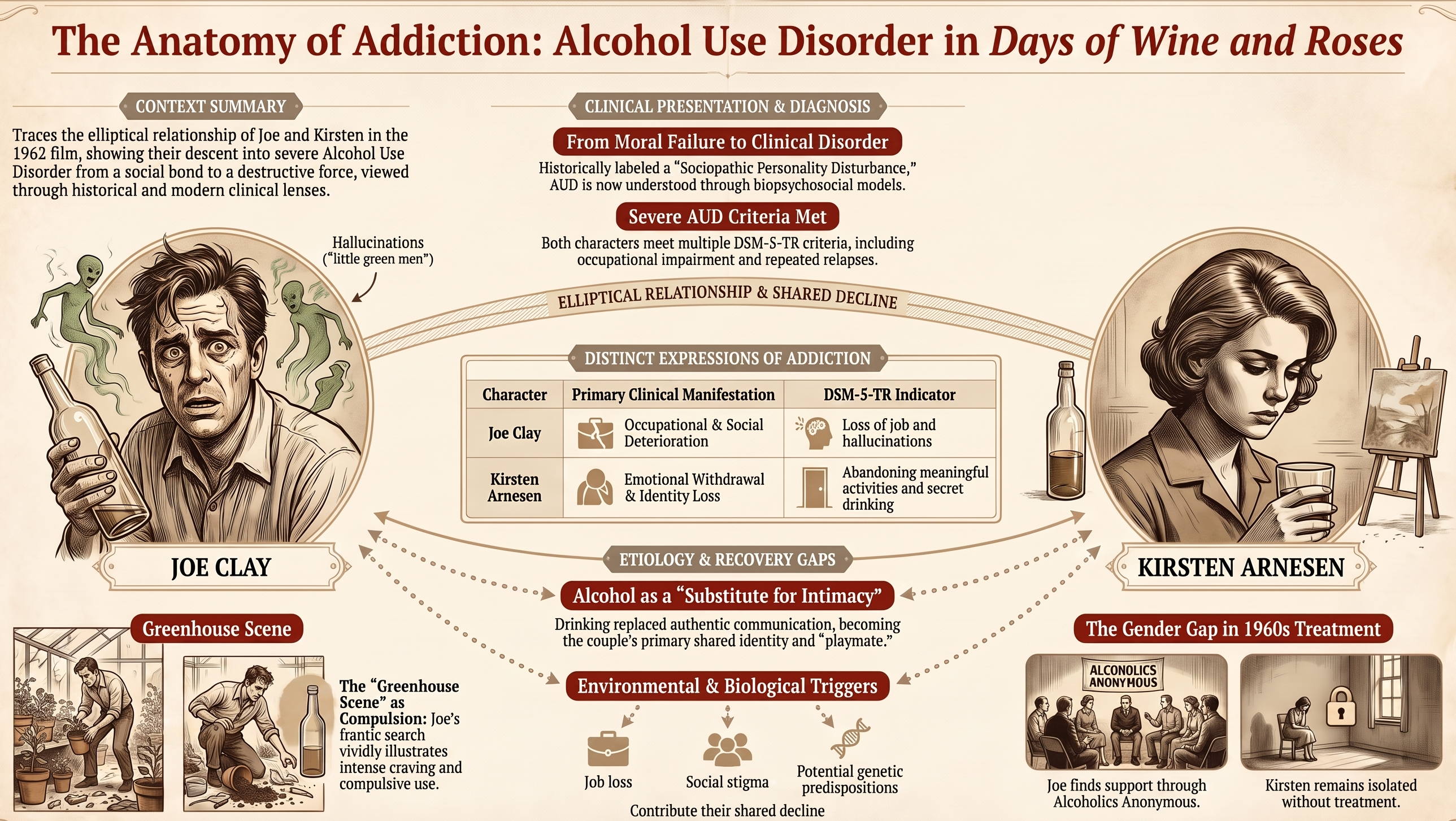
As addiction deepens, Joe’s decline is visible and loud: job loss, memory lapses, hallucinations during a desperate greenhouse scene where he tears apart flower pots searching for a hidden bottle. He eventually finds his way through Alcoholics Anonymous.
Kirsten’s decline is quieter. She drinks in secret, increases her coffee and medicinal alcohol, emotionally withdraws. When Joe gets sober, she resists recovery — not purely out of denial, but because sobriety has drawn a line between them and she is on the wrong side of it. A friend observes that Kirsten has lost her playmate. It sounds almost casual. It is clinically precise.
By the end, the film reveals a painful truth with very few words: alcohol can ruin marriages. And it does not always ruin both people equally.
When the Diagnosis Was a Moral Verdict
The film was released in 1962, during an era shaped by the first edition of the Diagnostic and Statistical Manual of Mental Disorders. At that time, what we now call Alcohol Use Disorder was categorized under Sociopathic Personality Disturbance, Alcohol Addiction — framed explicitly as a form of moral failure or character pathology, not as a medical condition with biological and psychological roots.
This matters enormously for understanding what Joe and Kirsten would have faced.
America has a complicated, cyclical relationship with alcohol. Prohibition (1920–1933) had positioned drinking as a moral and public health catastrophe — something to be legislated away. When it ended, the pendulum swung, and by the postwar era of the 1950s and 60s, drinking was socially normalized, even glamorized. Joe’s public relations industry didn’t just tolerate drinking; it practically required it. The same culture that handed him a glass also handed him a label — alcoholic, morally deficient — the moment he couldn’t put it down.
The DSM's language has evolved dramatically since then. The DSM-5-TR frames Alcohol Use Disorder through a biopsychosocial model — recognizing that addiction is sustained not by individual weakness but by a web of biological predisposition, psychological coping, and social circumstance. Joe would not have had access to that framing in 1962. He would have been told, essentially, that he lacked character.
The greenhouse scene lands differently knowing this. The man crawling through soil looking for a hidden bottle is not failing morally. He is living inside a neurological reorganization that the clinical tools of his era had no honest language for.
The Gender Gap No One Named
Kirsten receives no treatment in the film. This is not an oversight by the screenwriter. It is a portrait of reality.
In the early 1960s, addiction treatment was built around men. Alcoholics Anonymous, the dominant recovery pathway, was founded by men, structured around male fellowship, and implicitly oriented toward the kind of occupational and social deterioration that was visible in men. Women’s drinking, by contrast, was hidden — by shame, by social expectation, and by a clinical culture that either didn’t see it or preferred not to.
Kirsten's drinking is portrayed as isolating and shameful. She is left without structure or a recovery community. The film does not editorialize about this. It simply shows her alone at the end — and trusts the viewer to feel the weight of what was withheld from her.
The gender dimensions of addiction are real and measurable. Women tend to progress from first drink to dependence faster than men — a phenomenon researchers call telescoping. They are more likely to drink in response to relational stress, and more likely to face stigma that delays help-seeking. In Kirsten’s case, her recovery was also entangled with Joe’s. When he got sober, he gained a sponsor, a community, a daily structure. She gained nothing except the quiet suspicion that she was now the problem he had outgrown.
A contemporary approach to Kirsten’s care would look very different: gender-responsive treatment that integrates stigma reduction, relational dynamics, and family-oriented support. What she needed was not willpower. She needed someone to see her — not as Joe’s wife failing to follow his lead, but as a person with her own disorder, her own history, and her own need for care.
She did not get that. Many still don’t.
What I’d Fix in Myself
My first draft of this paper leaned too hard on diagnostic vocabulary. I spent sentences mapping symptoms to criteria when the film had already done that work more elegantly than I could in prose.
What Days of Wine and Roses understands — and what I want to learn as a writer — is restraint. Blake Edwards never tells you how to feel. He shows Kirsten alone at the end of a hallway, through frosted glass, and trusts that you already know. Alcohol in this film is not just a substance. It is a substitute for intimacy, identity, and escape.
There is no true laughter in Days of Wine and Roses, even in its lighter moments. The audience is always waiting for the other shoe to drop. That suspended dread — that knowledge of the fall before it comes — is the film’s great achievement. And it is also the thing I most want to carry into my own work: the discipline to make a point once, and then trust the reader.
Is there a film that changed how you understood a mental health concept? I’d be curious which one — and what shifted for you.
Comments