Your Stress Is Contagious. So Is Your Calm.
📍 Peak-Performance Psychology 📅 June 29, 2026 · 6 min read
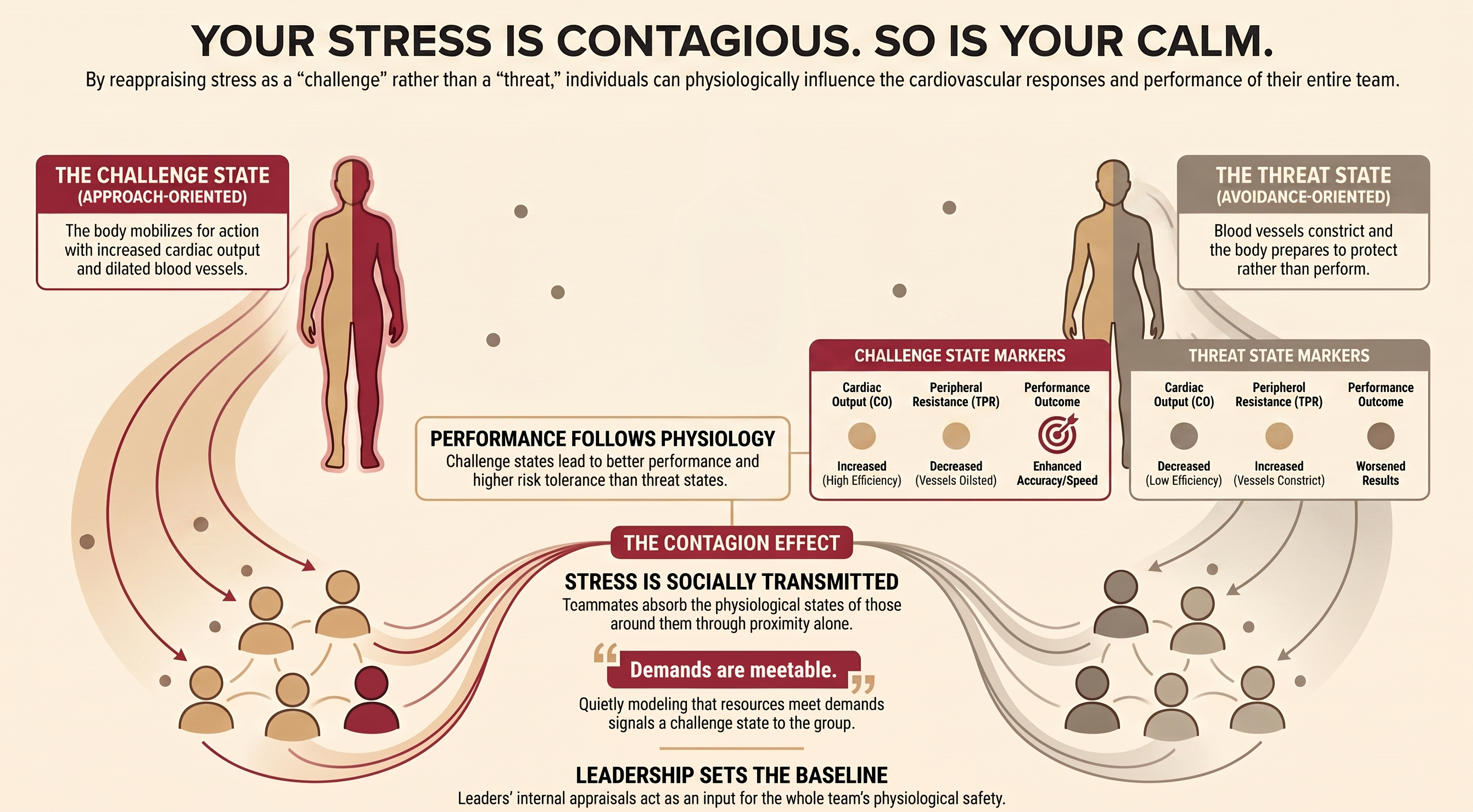
I used to think of stress as a private problem. Something I managed alone, ideally invisibly. A background process running on my own hardware — not something that leaked into the room. The research says otherwise.
These reflections come from my weekly readings and shaped by Oveis et al. (2020) on team stress reappraisal and contagion.
The Study That Changed How I Think About Teams
In 2020, Oveis and colleagues published a study on something most of us feel but rarely name: stress is socially transmitted. In a series of experiments, they found that when one person in a team reappraised their stress as a challenge — reframing their racing heart and heightened alertness as useful, not dangerous — that appraisal spread to their teammates through emotional contagion.
Not through words. Not through a pep talk.
Through proximity alone.
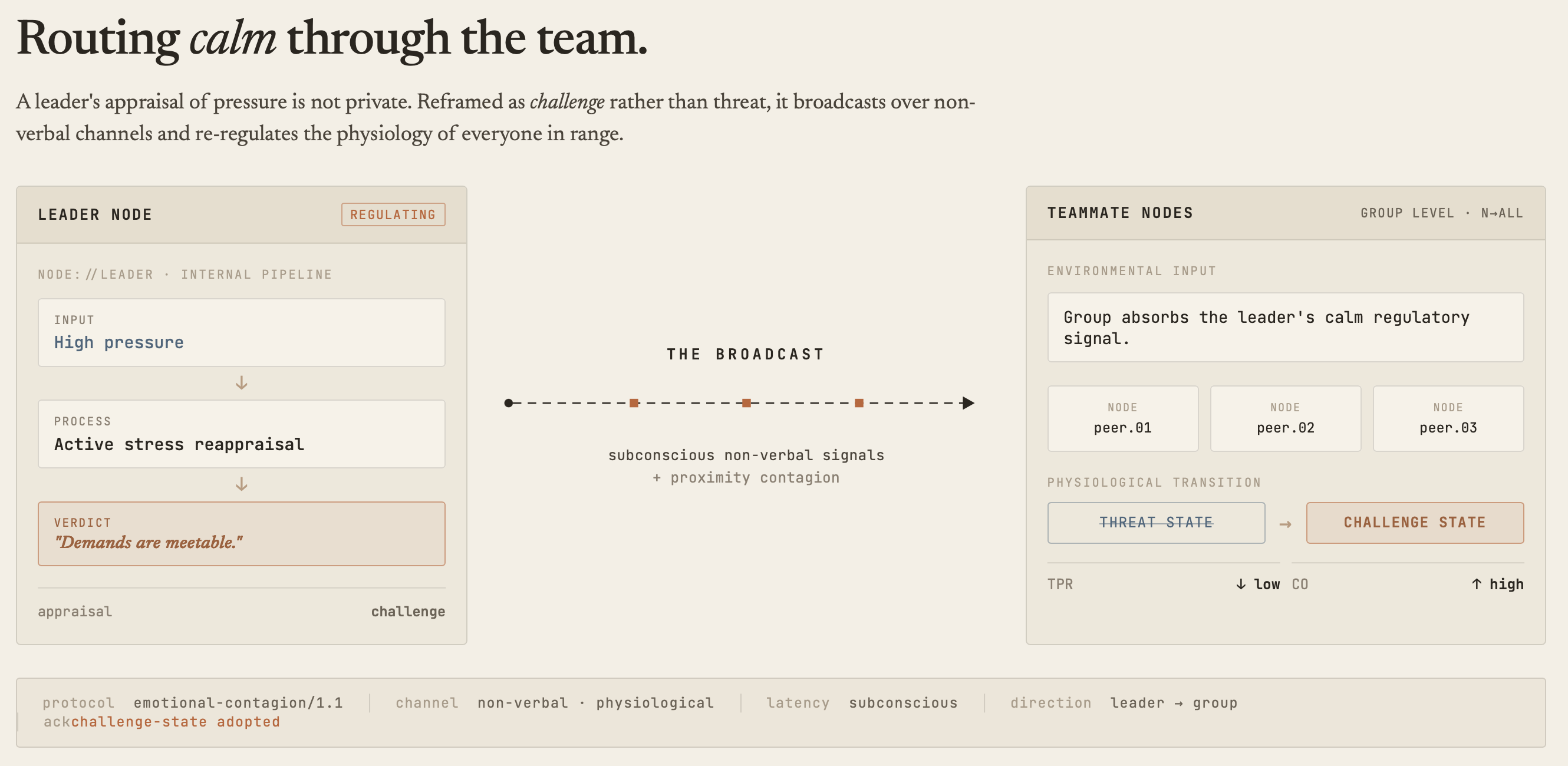
Teammates of stress-reappraisers showed measurable physiological changes: better cardiovascular profiles, more approach-oriented responses. The calm, reframed energy of one person reshaped the internal experience of everyone else in the room — even when no direct coaching or instruction was given.
This is the part that stopped me cold.
What That Means If You Hold Any Power
The implications are pointed, especially for anyone in a leadership or mentorship role.
If you walk into a high-stakes meeting projecting threat — blood pressure up, peripheral blood vessels constricting, body in defensive mode — the people around you do not simply observe your stress. They absorb it. Their own cardiovascular systems begin to shift toward a threat state, with measurable consequences for their performance, their risk tolerance, and their decision-making.
The reverse is also true. Someone who has learned to reappraise their own stress — who has internalized that a pounding heart is preparation, not alarm — carries that appraisal into shared space. And it lands.
The multilevel valuation model, which Oveis and colleagues extended with this research, now holds that stress appraisals are not just individual — they are relational. The way you process pressure in a room is, in part, an input into how the people near you process pressure.
The Part That Applied to Me
I have always known, at some level, that my stress was not invisible.
There have been moments — a deadline compression, a high-visibility screen-share, scope escalation, a conflict I did not see coming — where I could feel the shift in my own body before I had time to manage it. And I could also feel, in those moments, how others in the room pulled back slightly. Waited. Adjusted.
I used to read that as me failing to contain something I should have contained better.
The research reframes it: the stress was real and appropriate. The question was never whether to feel it — it was whether I had learned to reappraise it. A challenge state and a threat state produce similar physiological arousal. The difference is what the body does with that arousal.
In their study, Oveis and colleagues tracked specific cardiovascular parameters to differentiate these states: in a challenge state, cardiac output increases and blood vessels stay dilated, resulting in decreased total peripheral resistance (TPR) as the body mobilizes for action. In a threat state, the vessels constrict (increasing TPR), cortisol enters the system, and the body prepares to protect rather than to perform.
The body does not make this choice automatically. It takes a cue from the mind. And the mind takes a cue, in part, from the people around it.
In a recent field observation of a DevOps team I studied, I noticed this dynamic playing out. One person’s resource appraisal — “we take care of this” — changed the frame for the whole group. It was not a grand speech. It was the quiet broadcast of someone who had decided, internally, that the demands were meetable. And the team followed.
The Harder Implication
There is something uncomfortable in all of this for inclusion advocates.
We know that stress is not distributed equally. Minority stress — the chronic, background strain of navigating spaces not designed for you — is a real physiological load. It is not the same as acute competitive stress. It is cumulative, often invisible, and frequently unacknowledged by the people who do not carry it.
If stress is contagious and calm is contagious, then the baseline from which a team operates is partly set by who holds power in the room and how they carry their stress.
A leader who models adaptive reappraisal creates a room that is physiologically safer to perform in. A leader who does not — even inadvertently — creates a room where the threshold for threat is lower for everyone, and lower still for people who arrived already carrying additional load.
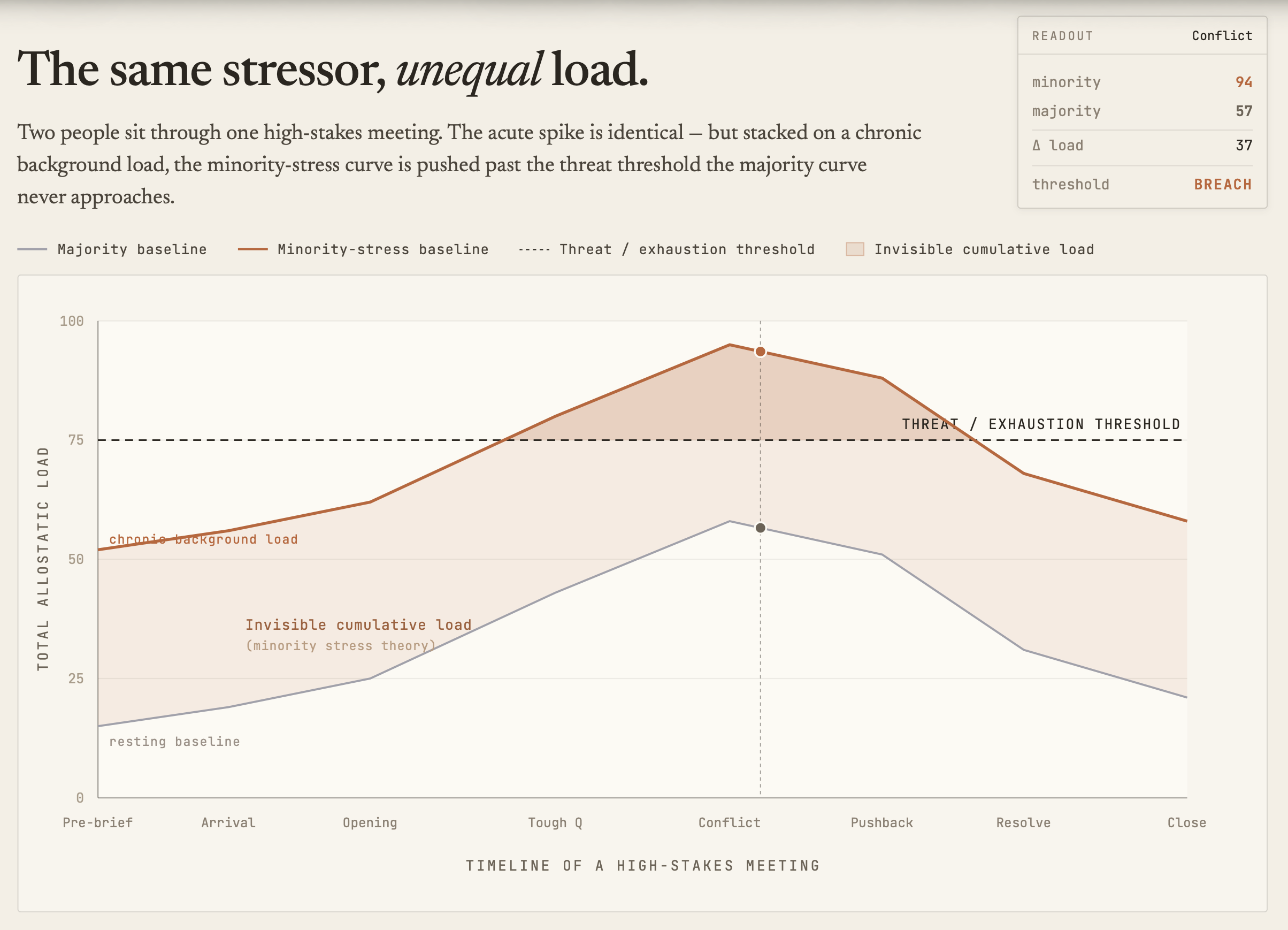
This is one of the quieter arguments for psychological safety: it is not just a cultural value. It is a physiological infrastructure. The body of every person in that room is, in part, running on the emotional signal of the people with the most positional power.
What I Do With This Now
I do not share stress in the old way anymore — as an outburst, a complaint, or a visible display of overwhelm. But I also do not pretend it is not there.
What I try to do instead is reappraise it in real time, and then let that be what’s visible. The acknowledgment that the situation is demanding. The signal that I believe the demands are meetable. The quiet broadcast that this is a challenge, not a catastrophe.
Not performance. The actual internal shift, made visible.
Because if my stress is contagious, so is my read of the situation.
And my read of the situation is something I can actually work on.
Have you ever noticed a colleague’s calm — or panic — become your own? I’d be curious what triggered it.
Comments