Defining Fairness Through Accessibility: The Invisible Tax of Shifting Baselines
📍 Psychometrics 📅 July 1, 2026 · 5 min read
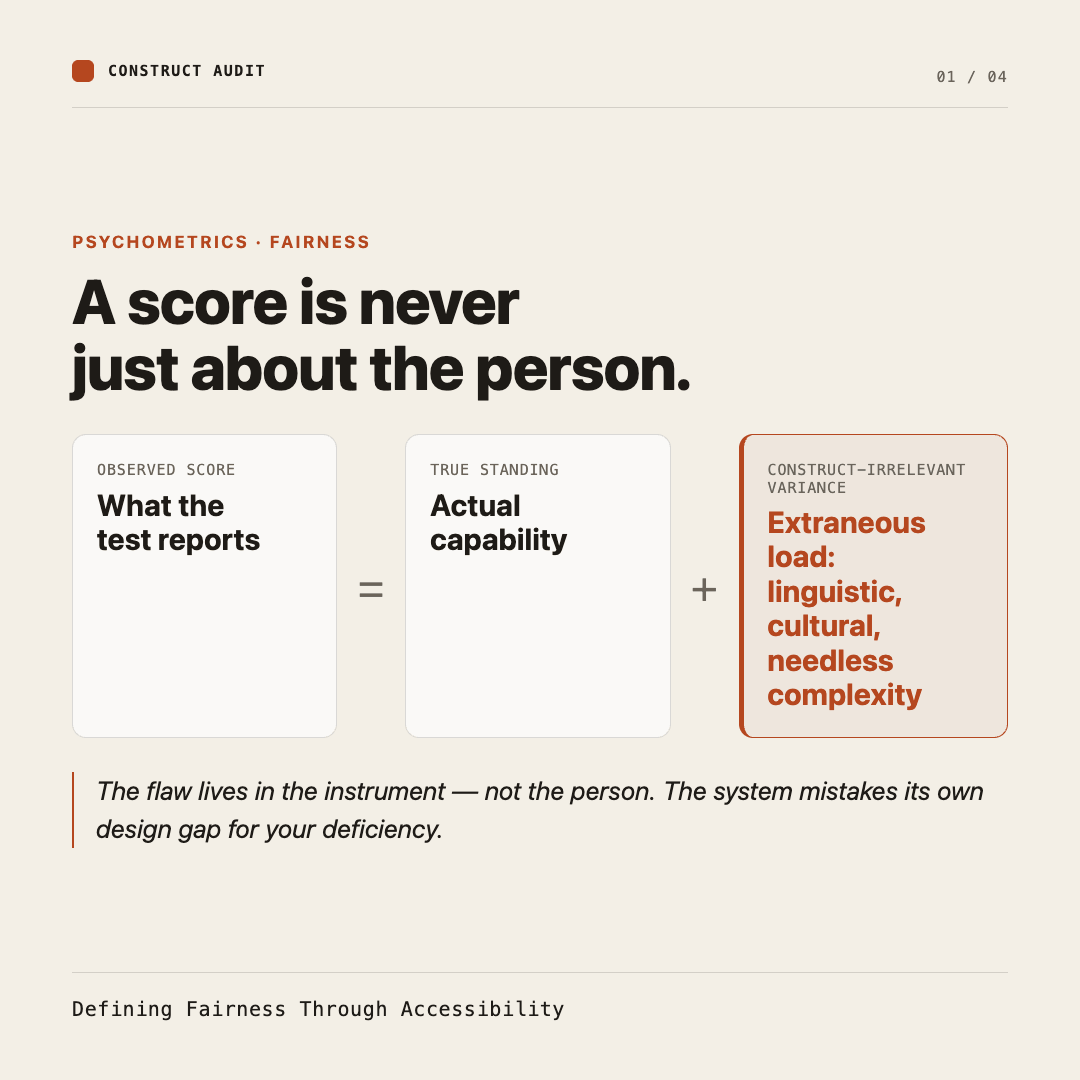
The burden of calibration always falls on the person crossing the boundary — while the baseline gets to call itself neutral.
What follows is a reflection on a coursework prompt about psychological assessment guidelines for diverse and underrepresented populations. These are personal observations, offered because the pattern underneath them is much larger than any single test.
Recently, I attended two traditional Indian weddings back-to-back, representing the groom’s side at one and the bride’s side at the other, and I watched the exact same dynamic play out. Within the same celebration space, two families shared the room with completely different facial expressions and levels of physical tension.
On one side, the groom’s family was entirely relaxed and chill. On the other side, the bride’s family carried a visible, heavy strain. This was not a localized fluke or a personal failing of specific hosts. It was simply the system being the system, an underlying structural patriarchial architecture working exactly as designed in plain sight. Almost no one else in the shared space registered the asymmetry. Nobody had to enforce the dynamic out loud. The default setting did the work quietly, the way a good default always does.
What unsettled me more than the inequality of emotions was noticing how far I have drifted from norms I once moved through without question — and realizing that analytical distance is not the same as leverage. I could reproduce the defect on demand and trace it to root cause. I still had no power to alter it.
Awareness without leverage is its own sharp kind of discomfort.
The tax nobody itemizes
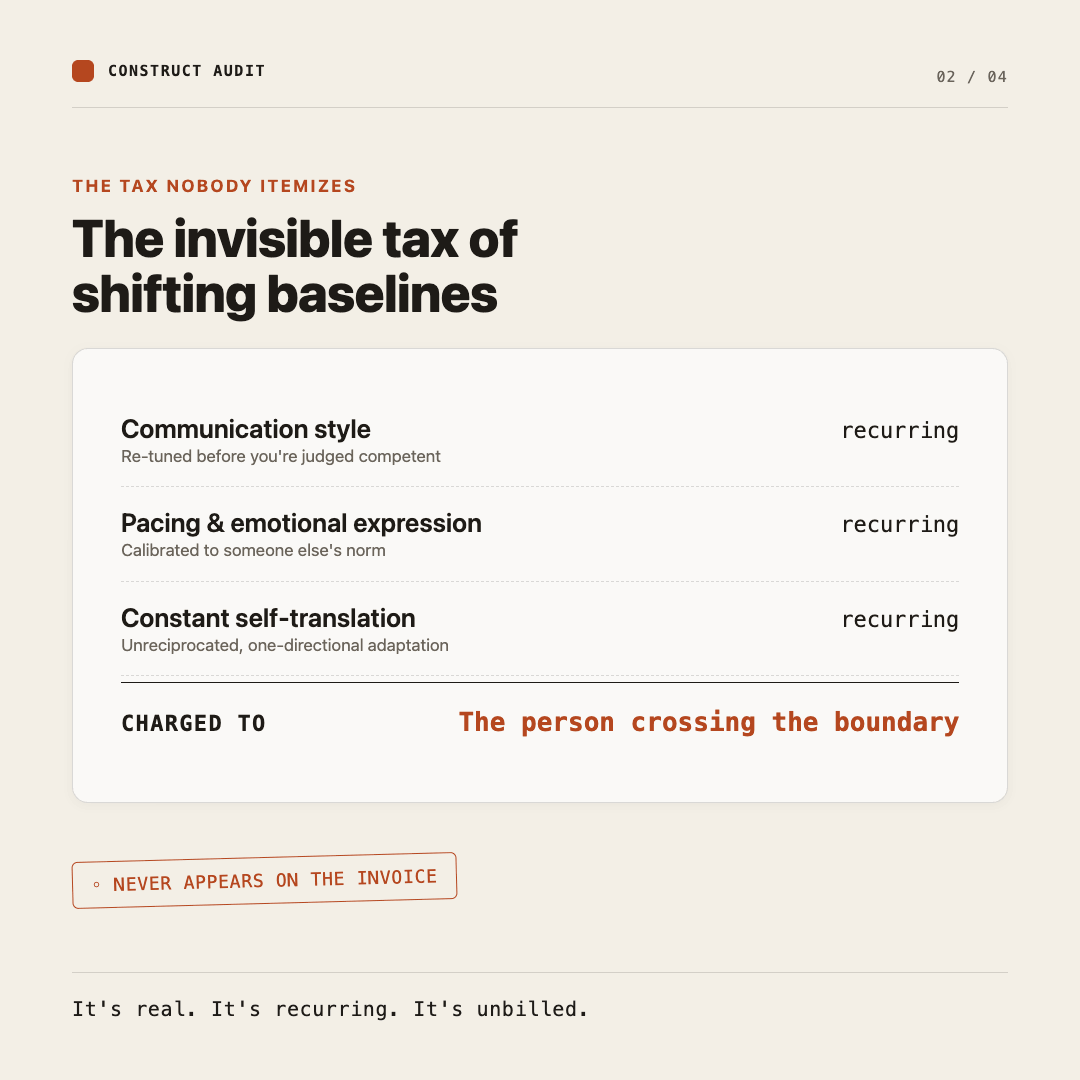
The distance between two cultural baselines is rarely measured in miles. It’s measured in the silent energy required to translate yourself into someone else’s norm. For anyone living outside a dominant default, cultural difference doesn’t show up as variety. It shows up as a structural deficit that demands constant, unreciprocated adaptation.
Anyone who has worked a career across cultural boundaries knows this in their body. It’s the quiet, extra work of making sure your communication style, your pacing, your emotional expression all land safely before someone decides whether you’re competent. The burden of calibration belongs entirely to the person crossing the boundary. The structure underneath never gets audited.
I’ve come to think of it as a tax. It’s real, it’s recurring, and it never appears on the invoice.
Where the reading gave me a name for it
The Standards for Educational and Psychological Testing, published collaboratively by the three bodies that form the absolute governing coalition for psychometrics in the United States (the American Educational Research Association, the American Psychological Association, and the National Council on Measurement in Education), sets a principle I keep returning to:
fairness is not an operational footnote. It is a validity issue, one that has to be attended to at every stage of building and using a test.
The Standards define fairness through accessibility: an accessible measure lets everyone in the intended population demonstrate their actual standing on what’s being measured, without being advantaged or disadvantaged by characteristics irrelevant to the construct. When a tool fails that bar, it introduces construct-irrelevant variance — extraneous load (linguistic, cultural, needless complexity) that systematically pushes scores up or down for identifiable groups.
That term did something for me. It says the flaw lives in the instrument, not the person. The system penalizes whoever doesn’t match an uncalibrated baseline, and then mistakes its own design gap for that person’s deficiency.
The diagnostic trail
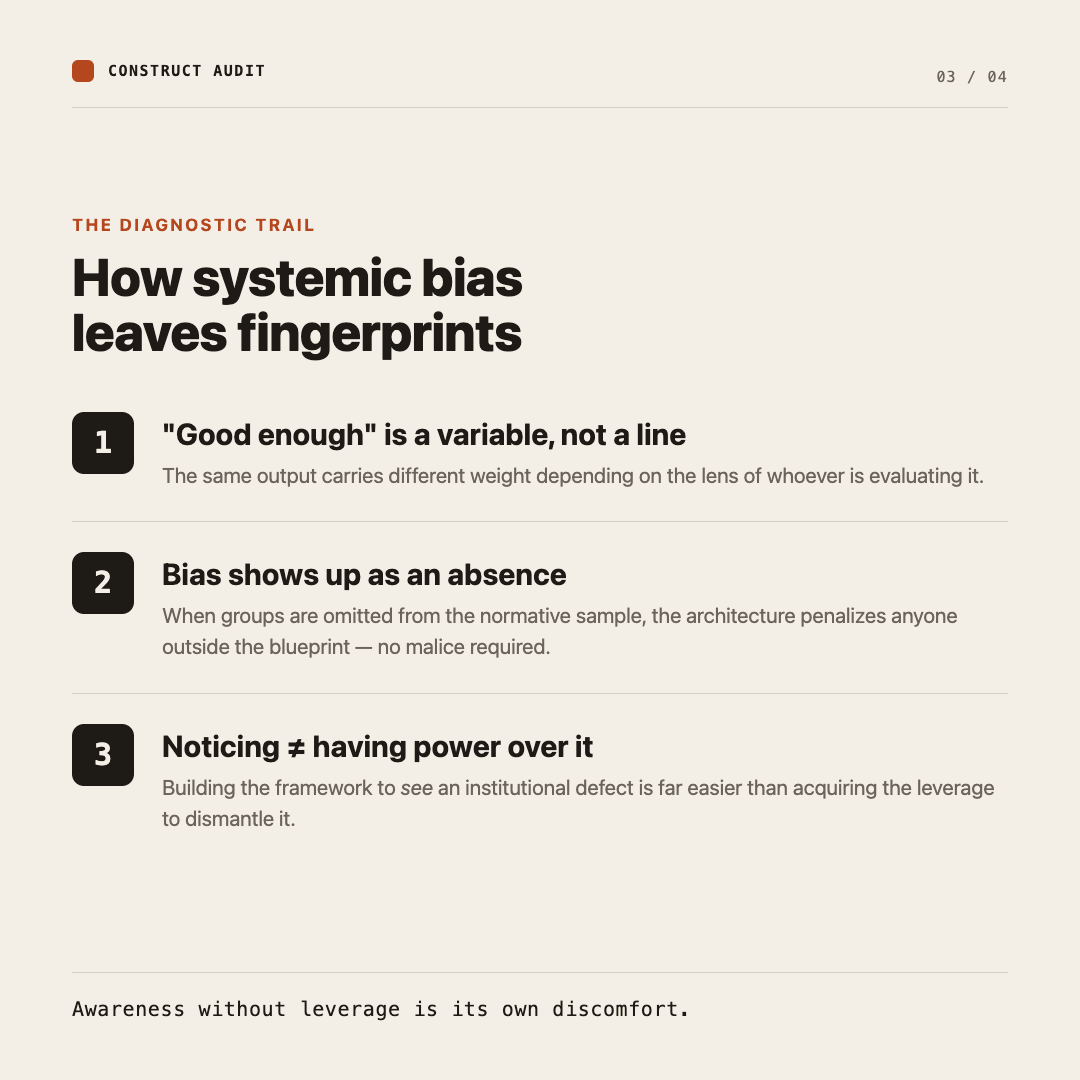
When systemic bias meets cultural difference, it leaves a specific trail:
- “Good enough” is an environmental variable, not a fixed line. The same output carries different weight depending on the lens of whoever’s evaluating it.
- Bias shows up as an absence, not just an error. When underrepresented groups are omitted from the normative samples a system is built on, the architecture penalizes anyone outside the blueprint — no malice required.
- Noticing an asymmetry and having power over it are two different skills. Building the framework to see an institutional defect is far easier than acquiring the leverage to dismantle it.
Negotiating for clarity
There is no clean fix for a threshold calibrated long before you ever entered the room. The only move I have found is to name the mechanism precisely, instead of carrying it as a vague, low-grade sense of personal inadequacy. Negotiating for clarity means refusing to let the terms stay unspoken. Naming the mechanism stops me from mistaking a structural design flaw for a verdict on what I am actually capable of.
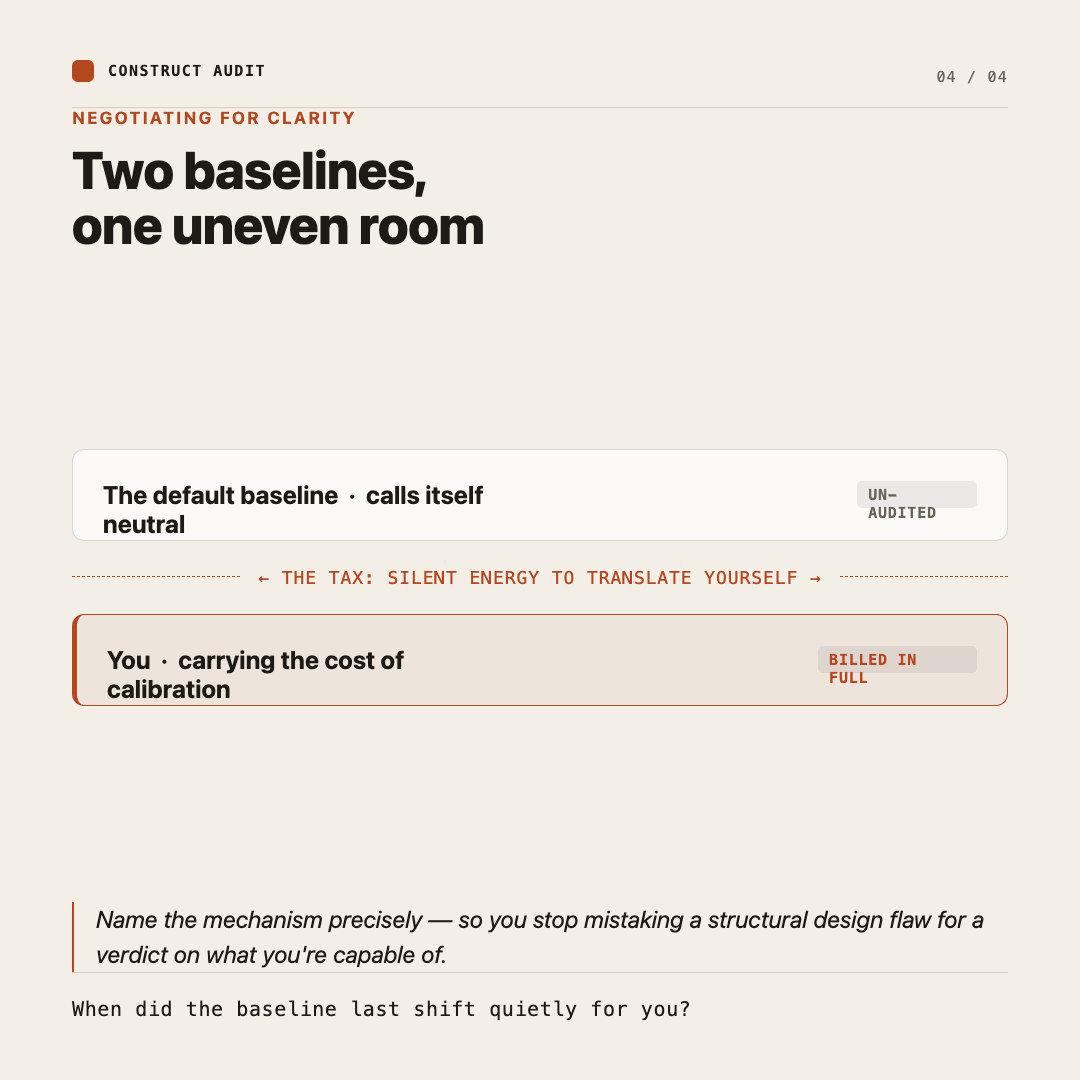
Most of us are carrying the weight of a shifting bar somewhere, and most of us have never seen the blueprint that proves it was not us.
When was the last time the baseline quietly shifted for you and were you able to identify and name it?
Comments