What My Career Anchors Said About the Work I Actually Want
📍 Optimizing Leadership 📅 July 4, 2026 · 6 min read
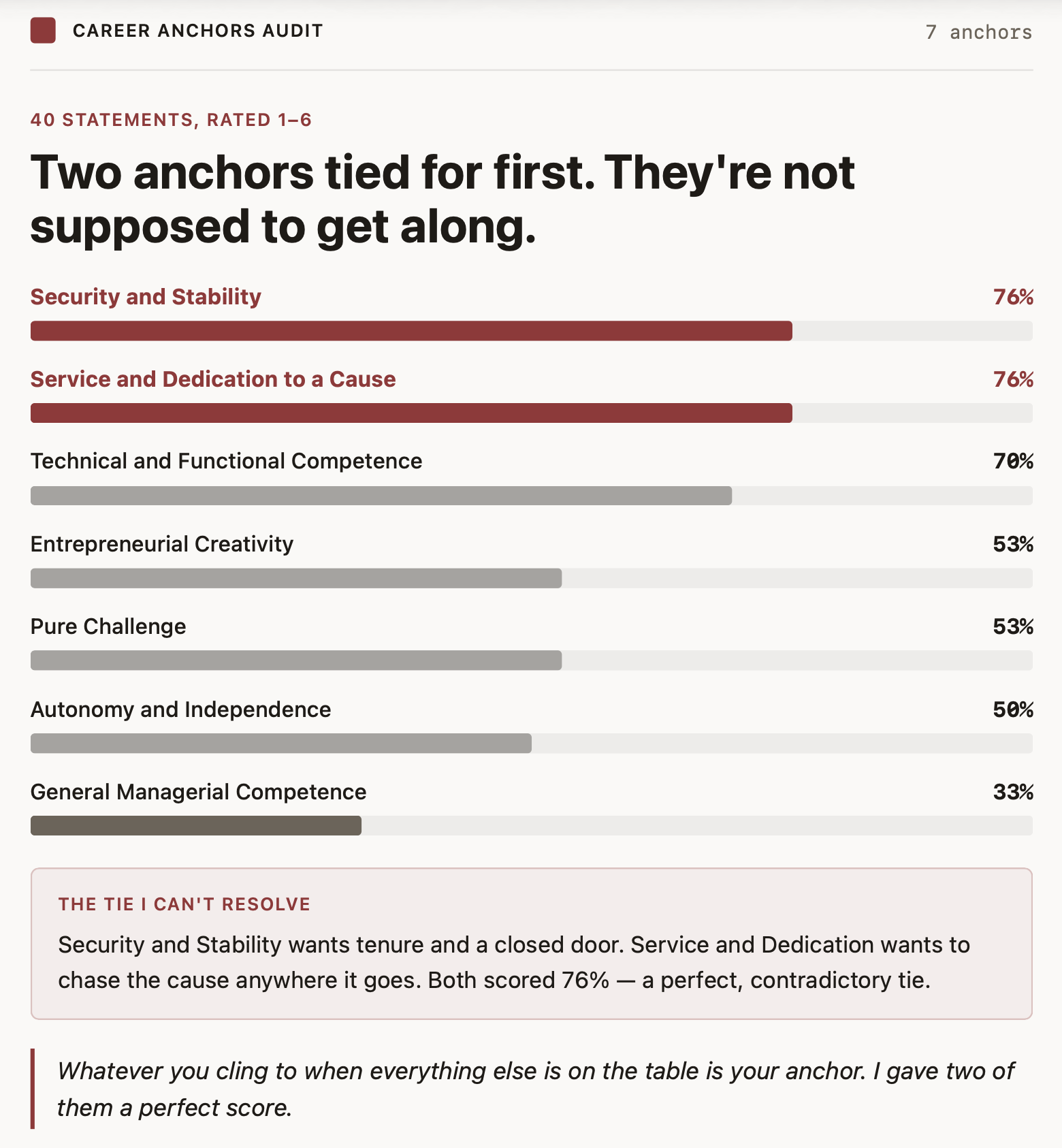
My top two career anchors tied for first place. In Schein's model, they aren't supposed to be roommates.
The data returned a tie I couldn’t argue my way out of. One anchor wants absolute stability; the other wants a cause. In Schein’s model, they aren’t supposed to be roommates, but they’ve been running my career ever since.
Ask most people what they want from a career and you’ll get the polished answer. A good assessment is built to get underneath it.
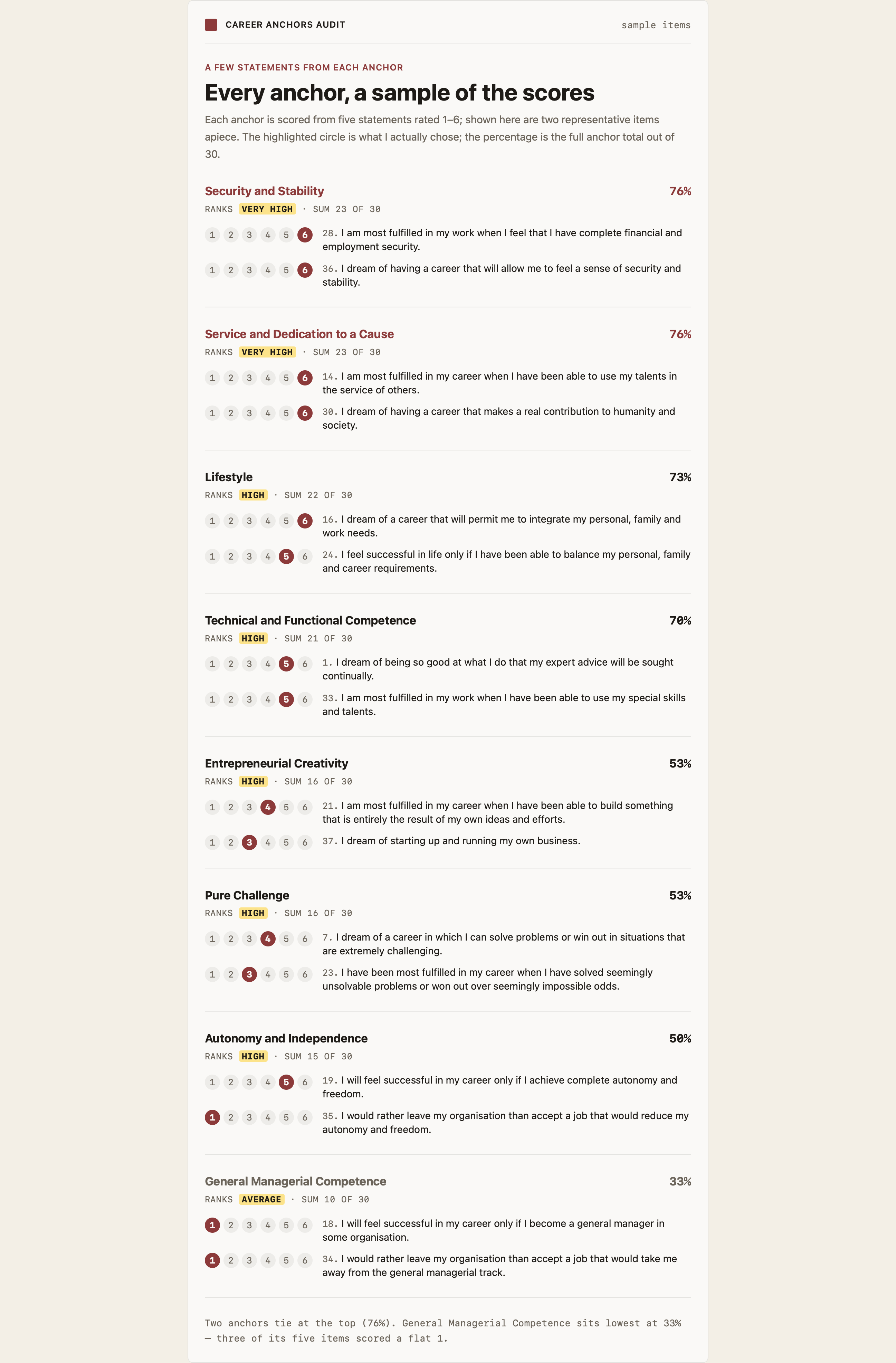
Two of my seven career anchors came back tied at 76 percent. One was Security and Stability. The other was Service and Dedication to a Cause. I sat with that result longer than I expected to, because in Edgar Schein’s model those two are not supposed to be roommates, and I had somehow scored them as equal partners.
For each of the forty items, rate how true it is for you in general, from 1 (never true) to 6 (always true).
Forty statements, each rated one to six — the kind of self-report where you can feel your hand drifting toward the answer you’d prefer to be true. In that scale, the value is not just the number; it is the design that tries to outmaneuver social desirability bias and surface the construct you are actually anchored to, not just the version of yourself you want to be. Schein built the method back in the 1970s to surface the one thing a person will not trade away when a job forces the choice. Whatever you cling to when everything else is on the table is your anchor.
The tie I can’t resolve
On the security questions I didn’t hedge at all. “I am most fulfilled in my work when I feel that I have complete financial and employment security” got a six from me, the top of the scale, always true. “I dream of a career that will allow me a sense of security and stability,” another six. A few items later, I handed the same maximum score to wanting my work to contribute to humanity, and to using my talents in the service of others.
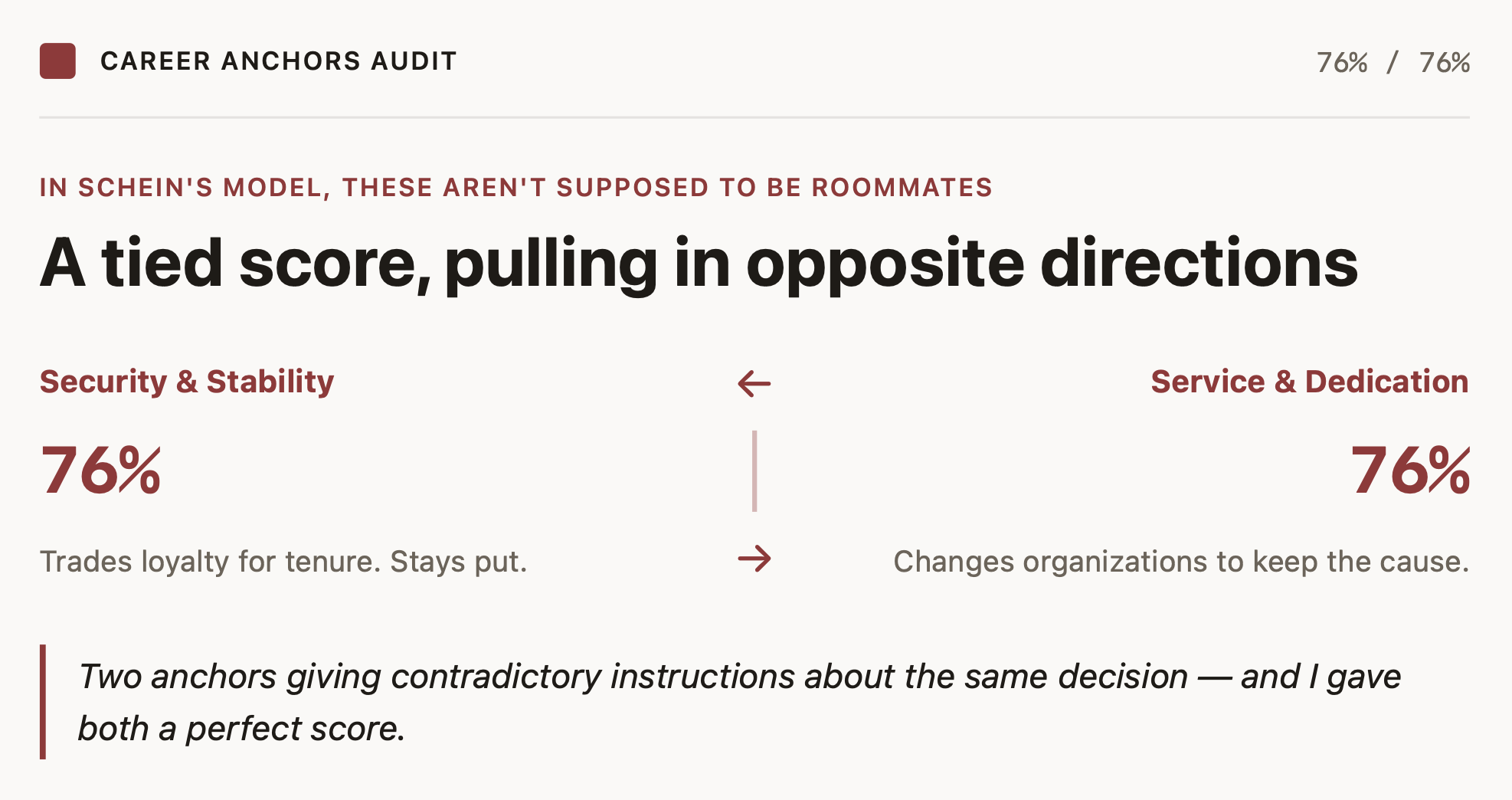
Those two maxed-out wants don’t behave the same way in the real world. Schein’s description of the service anchor says the quiet part plainly: people anchored there will change organizations to keep following the cause, and turn down promotions that pull them away from it. The security anchor does close to the opposite. It trades loyalty and flexibility for the promise of tenure, and it stays put. So I have two anchors giving me contradictory instructions about the same decision, and I gave both of them a perfect score.
The one I scored lowest
General Managerial Competence landed at 33 percent, further down than anything else by a clear stretch. When the test asked whether I’d only feel successful as a general manager, I rated it a one. When it asked whether I’d quit rather than be pulled off the management track, one again. I don’t want to run the organization. What I want is to be genuinely good at a craft and then be left alone to get better at it, and the assessment caught that in a 70 percent on Technical and Functional Competence.
That part didn’t surprise me. I already knew I’d rather be the person a team trusts on the hard technical call than the person managing the people who make it. Seeing it in a number just made it harder to keep pretending otherwise on days when a management title looks like the obvious next rung.
The number I want to argue with
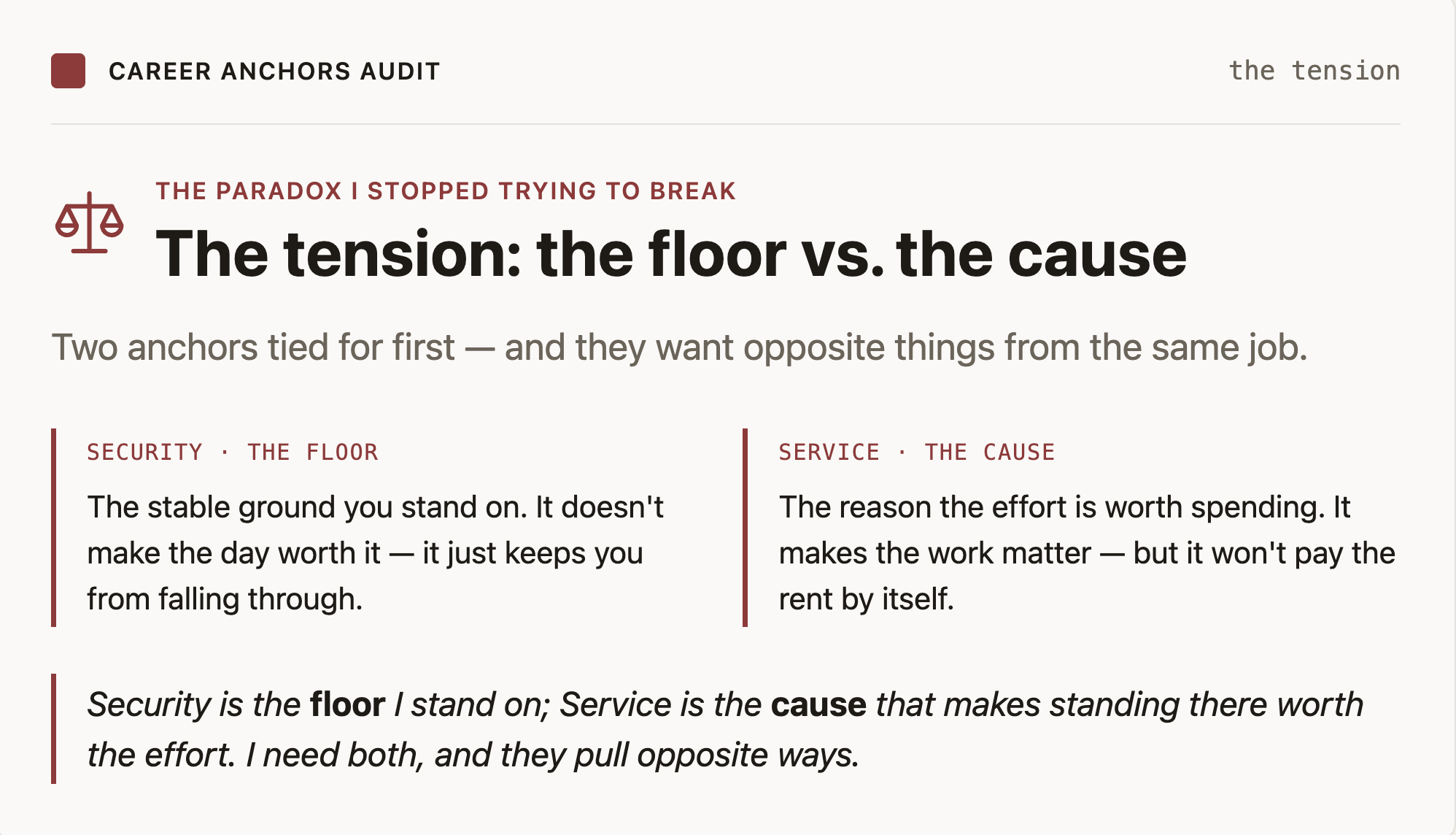
The security score is the one that stings a little. I like telling a story about myself as someone drawn to service, willing to take a risk for something that matters. The data says that I also, steadily and without much drama, want a pension and a door that locks behind me. When you have rebuilt a life across borders more than once, a reliable paycheck and a bit of stability stop reading as luxuries and start feeling like the floor you’re standing on. It’s hard to be brave about your cause when you’re not sure the ground will hold.
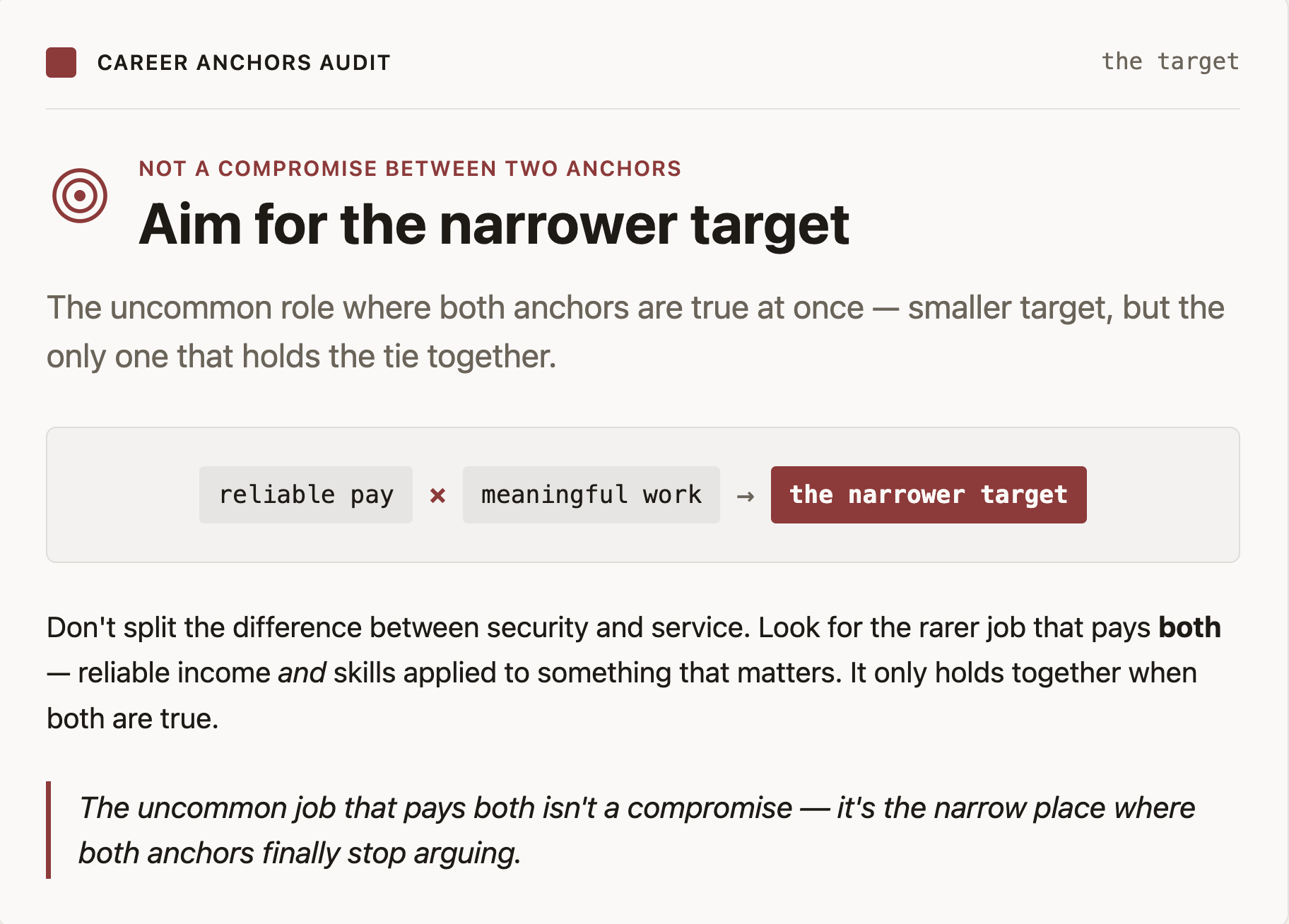
Knowing this changes how I read my own ambitions. The work I actually want has to do two unglamorous things at once: pay reliably, and point my skills at something I believe is worth the effort. That’s a narrower target than I’d have admitted a year ago, and it’s the first time the target has felt accurate.
My throughline is negotiating for clarity, and this is what that looks like turned inward: not a cleaner answer, just an honest map of the two things I have to satisfy at the same time.
Update, a year on. The tie still hasn’t broken — but what I did next changed. I spent the year pushing, on purpose, for the fusion inside the room I already had: operational rigor in service of people doing hard, high-stakes work. Some of that was met. A lot of it wasn’t, and I’ve had to sit with what it means to name a thing clearly and still not get it handed back to you.
Here’s what survived the year anyway: the fusion is real, and it’s find-able — in the job you already have, if that room will meet you halfway, and if it won’t, in the next one. I don’t know yet which one is mine. What changed is that I stopped treating the tie as a flaw to correct and started carrying it as the question I bring into every room I’m in, or think about walking into.
One more thing worth naming, because it might be yours too. Somewhere in this conversation, someone read my own situation back to me — plainly, without trying to fix it — and it landed harder than any of the numbers above. I had already said all of it myself. Hearing it in someone else’s words was what made it impossible to keep holding at arm’s length, and for a moment it was genuinely a lot to take in. If an assessment, or a conversation, ever hands you the truest sentence about your own life before you’ve managed to write it yourself, let yourself feel it. That’s not the audit breaking down.
That’s the audit finally working.
Thanks for reading. If you’ve ever taken an assessment like this, here’s what I’m curious about: which result did you quietly want to argue with — and did you end up trusting the number, or the story you’d rather tell about yourself?
See examples of test items per career anchor
Comments