Brave Spaces vs. Safe Spaces: What Group Coaching Taught Me About Holding a Room
📍 Group Coaching 📅 July 5, 2026 · 6 min read
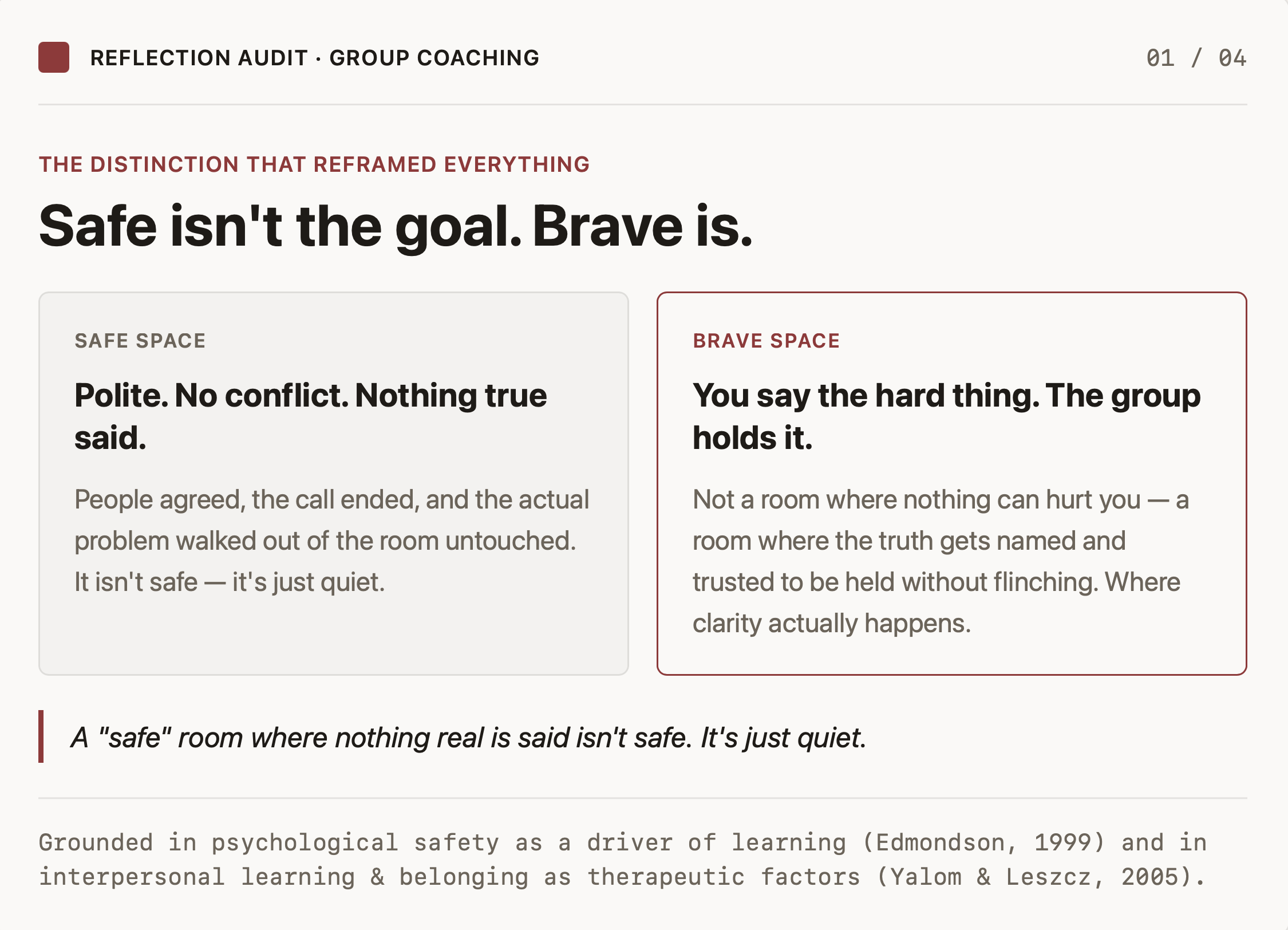
Group coaching taught me that a 'safe' room where nothing real is said isn't safe. It's just quiet.
Below are two reflection papers from a weekend-long group coaching intensive — one written before I had coached anyone, one after I co-facilitated a live session less than a day later. They belong together: the second only makes sense against the blind spots I confessed in the first.
Most of us have sat in a meeting that everyone would call safe. Polite. No conflict. And nothing true was said. People agreed, the call ended, and the actual problem walked out of the room untouched.
A weekend-long group coaching intensive pulled apart why that happens, and what the alternative looks like. The alternative has a name I did not expect to like: a brave space. Not a room where nothing can hurt you, but a room where you can say the hard thing and the group can hold it.
I learned the difference the slow way, by writing down what I was bad at first.
The assignment
The first paper asked me to name my blind spots and growth edges before I had coached anyone. The second came after:
Consider your experience in the group coaching workshops from two perspectives: as a coach and as a participant. What did you notice about how groups function differently than individuals? How did you experience managing multiple perspectives at once? What felt most challenging, and what came most naturally?
Two papers written about fifteen hours apart, on either side of one overnight, during the same weekend: the first a confession, the second a report from the field.
What I admitted before I started
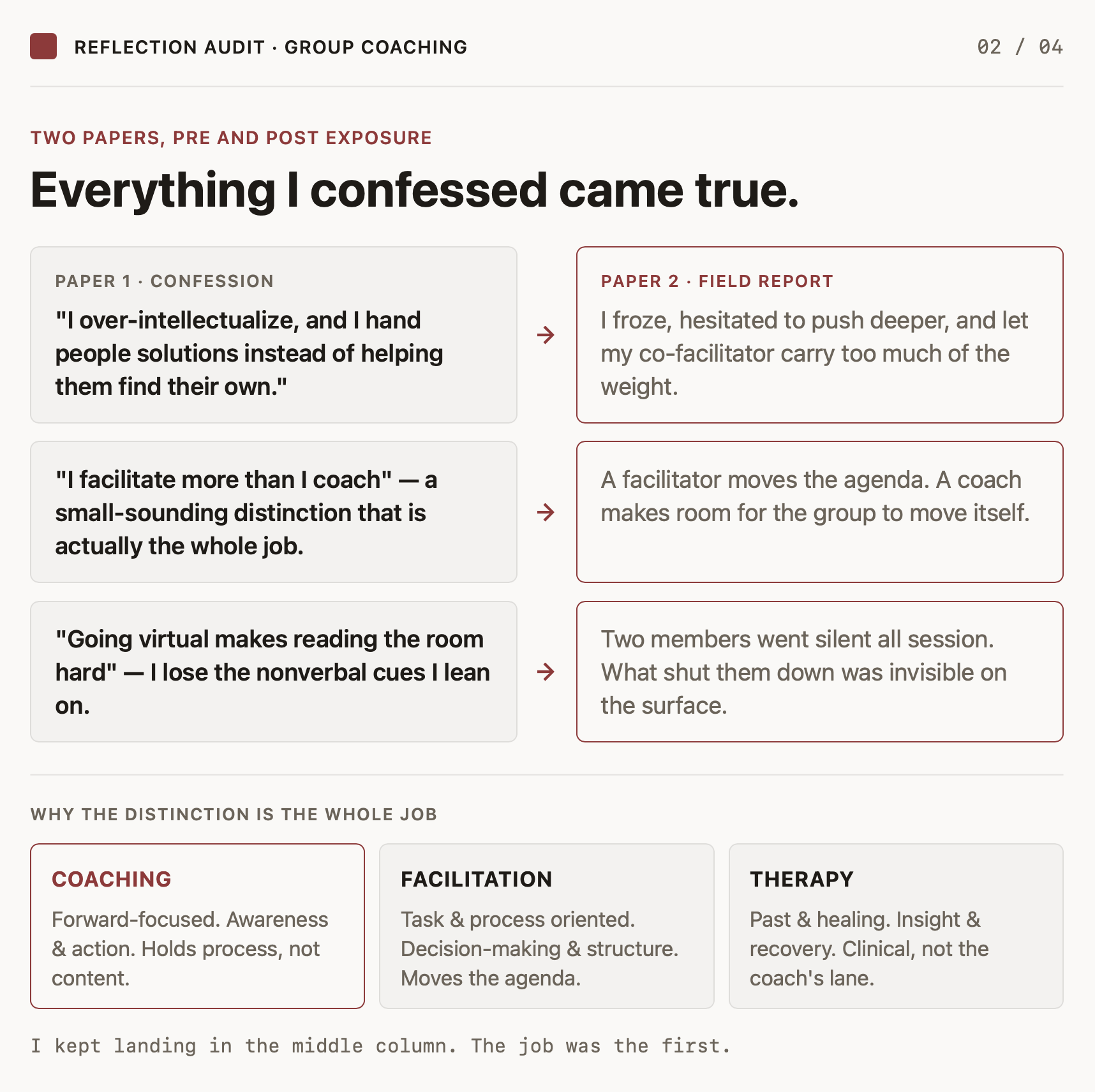
I did not flatter myself in the first paper, and I am glad, because everything I wrote came true in the second.
I wrote that I over-intellectualize. That when people look to me for a solution, I give it to them instead of helping them find their own. That I “often find myself facilitating more than coaching,” which sounds like a small distinction and is actually the whole job. A facilitator moves the agenda. A coach makes room for the group to move itself.
I also wrote that I underestimate the culture of knowledge hoarding around me, and that going virtual made reading the room much harder, because I lost the nonverbal cues I lean on. And I named the one strength I most believe in: I give a voice to institutionally marginalized people. I think that is my best contribution to any team. It is also, I now see, easier to claim than to do.
What actually happened when I coached
Then I co-facilitated a session of more than ten people. The topic was finding yourself inside a group and living with the consequences of expectations, met and unmet.
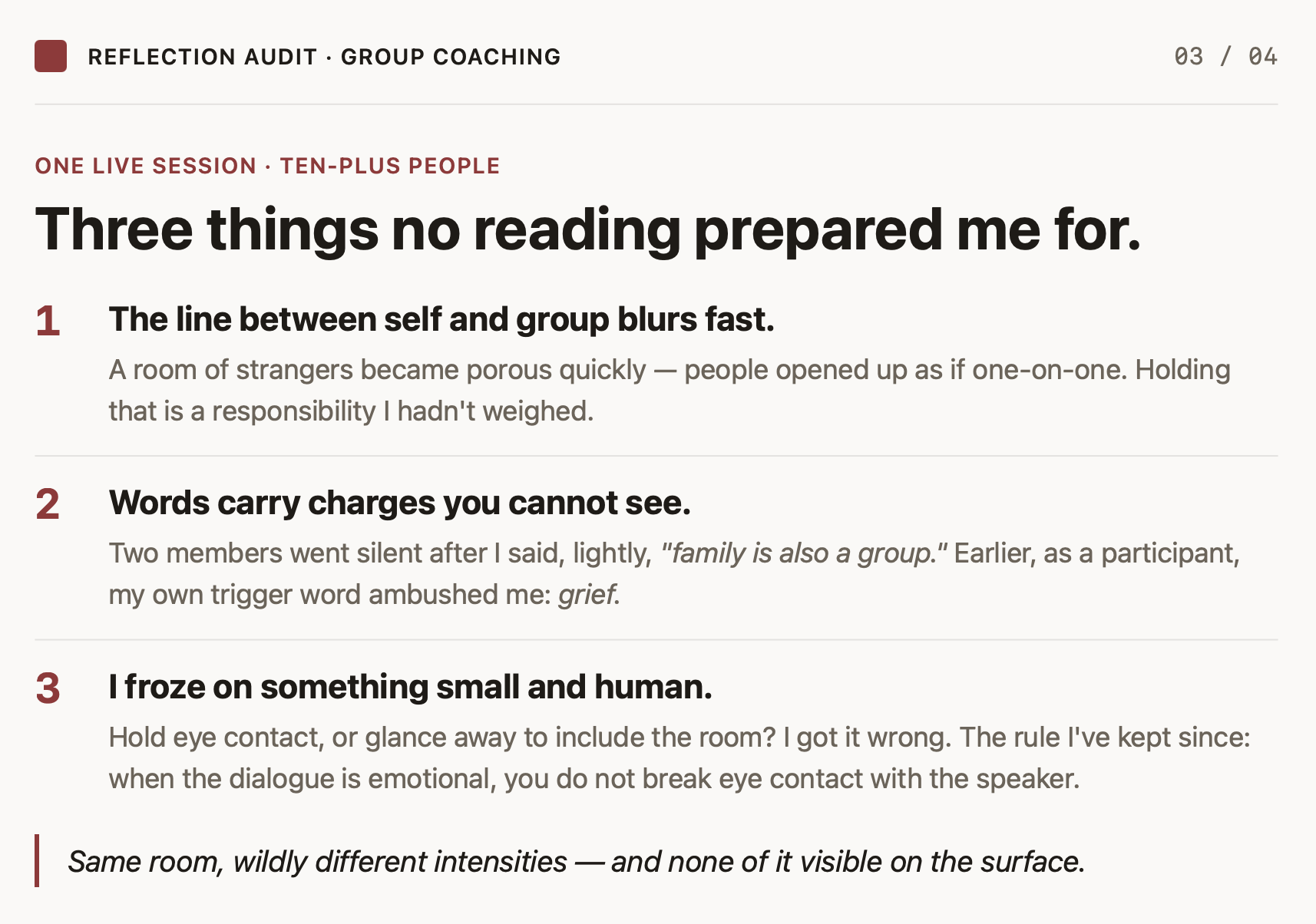
Three things landed that no reading had prepared me for.
- The boundary between self and group blurs faster than you think. People opened up to the group the way they might one-on-one. A room of strangers became porous quickly, and holding that turned out to be a responsibility I had not weighed.
- Words carry charges you cannot see. Two members stayed silent the whole session. Afterward they told me the moment that shut them down was during the icebreaker, when I said, lightly, “family is also a group.” That was their trigger. I only understood because earlier, as a participant, I had been ambushed by my own trigger word: grief. Same room, wildly different intensities, none of it visible on the surface.
- I froze on something small and human. A group member was sharing something emotional, and I could not decide whether to hold steady eye contact or glance away to include the room. I got it wrong. The supervising coach told me afterward:
When the dialogue is emotional, you do not break eye contact with the speaker.
I have not forgotten it since.
I will be honest about the rest too. I felt intellectually unprepared for the perspectives flying around, and I was hesitant to ask the follow-up question that would push someone to go deeper. I let my co-facilitator carry too much of the emotional weight. Given another turn, I would split that load evenly.
What a brave space actually requires
Somewhere between the two papers, my definition of a good coach changed completely. Here is where it landed.
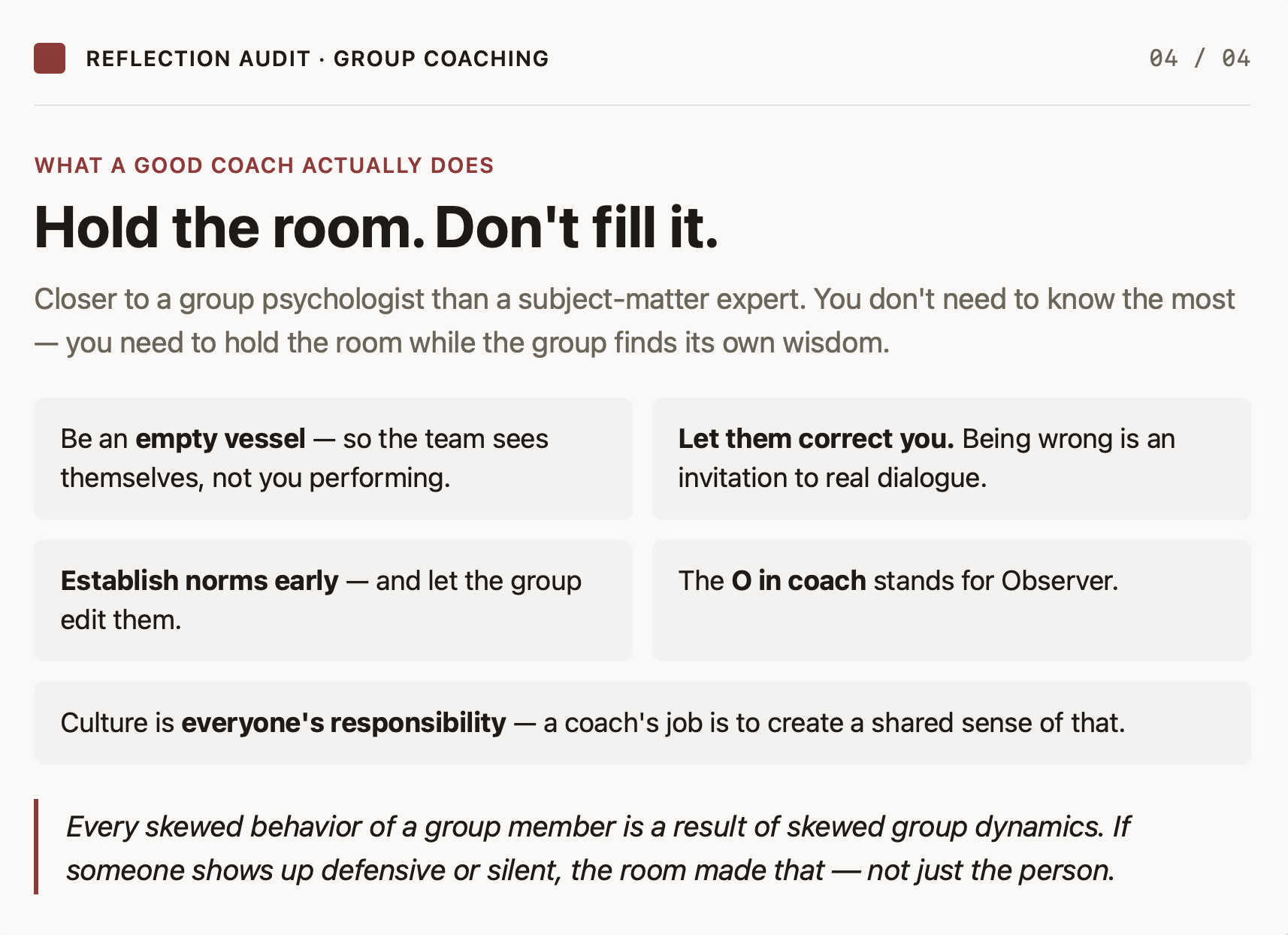
A coach is closer to a group psychologist than a subject matter expert. You do not need to know the most about the content. You need to hold the room while the group finds its own wisdom. As I wrote it: the coach “creates and holds brave spaces,” brings out the extremes and the quiet poles, and turns a fragile moment into something the whole group can grow from.
A few lines from my own list of takeaways still run my thinking:
- Be an empty vessel, so the team can see themselves in the space instead of watching you perform.
- Let them correct you. Do not be hard on yourself for being wrong; being corrected is an invitation to start a real dialogue.
- Establish norms early, and let the group edit them.
- The O in coach stands for Observer.
- Culture is everyone's responsibility, and a coach's job is to create a shared sense of that.
And the one I keep returning to, a process comment I wrote almost as a warning to myself: every skewed behavior of a group member is a result of skewed group dynamics. If someone shows up defensive or silent, the room made that, not just the person.
Why this is my kind of work
My throughline is negotiating for clarity, and group coaching turned out to be the purest version of it I have practiced. Safety alone produces a quiet, agreeable room where the real thing never gets said. A brave space is where clarity actually happens, because people can name the hard truth and trust the group to hold it without flinching.
I came in believing my gift was giving marginalized voices room to speak. I left understanding that giving room is only half of it. The other half is staying regulated enough, present enough, and quiet enough that the room does not need me to fill it. The person who was silent all session was not disengaged. She was waiting to see if it was safe to be brave.
Thanks for reading. A question I mean sincerely for anyone who runs meetings: is your room actually safe, or only quiet? And would you know which of your own words is somebody’s trigger?
Comments