The Personality Score I Didn't Pay For: A Big Five Snapshot & the Textbook Page That Found Me
📍 Organizational Behavior 📅 July 9, 2026 · 6 min read
The free report gave me one number and a paywall. The week's reading gave me something harder: a page that described a season of my working life back to me.
For an organizational-behavior course I took an online Big Five assessment and read the personality chapter the same week. The screenshot below is the actual result — one score, one paywall. This is the most personal of my coursework notes and the one I most considered keeping private. I’m publishing it because the reason I hesitated is exactly the point.
Most of us take a personality test hoping to be flattered, or at least entertained. We brace for a label we can post — an animal, a color, a four-letter code. What we’re rarely braced for is the reading that’s simply, quietly accurate about a part of ourselves we’ve been managing not to look at.
One number and a paywall
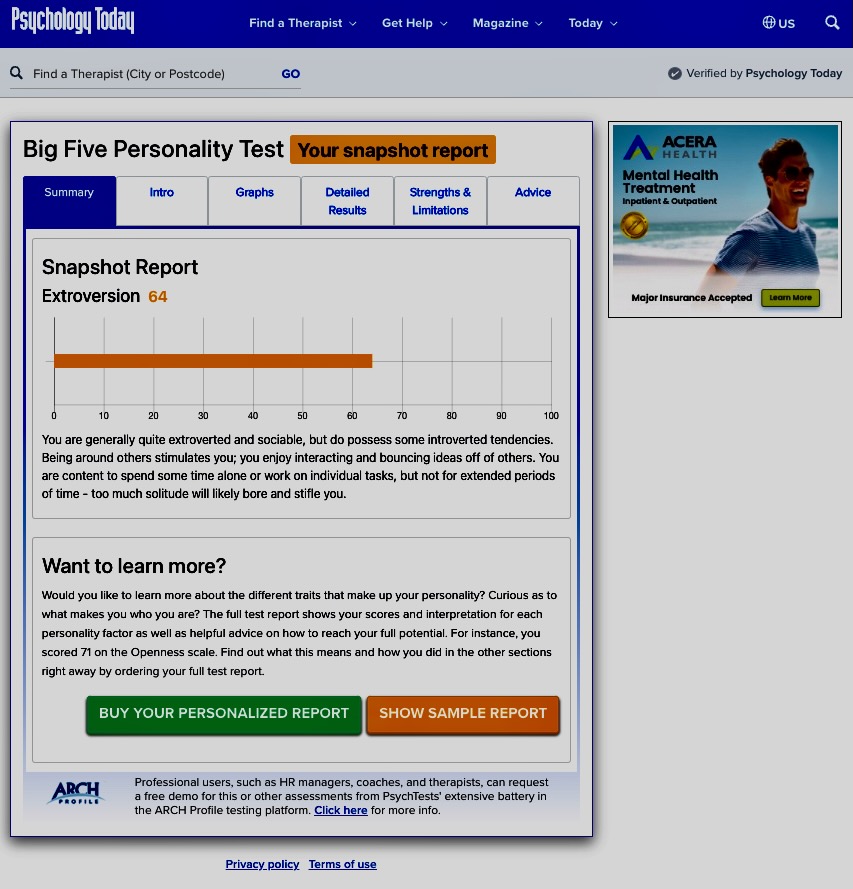
The test handed me a 64 on Extroversion: “generally quite extroverted and sociable, but do possess some introverted tendencies… too much solitude will likely bore and stifle you.” Fair. Aligned with how I understand myself. And then the snapshot report ended and the button appeared: buy your personalized report.
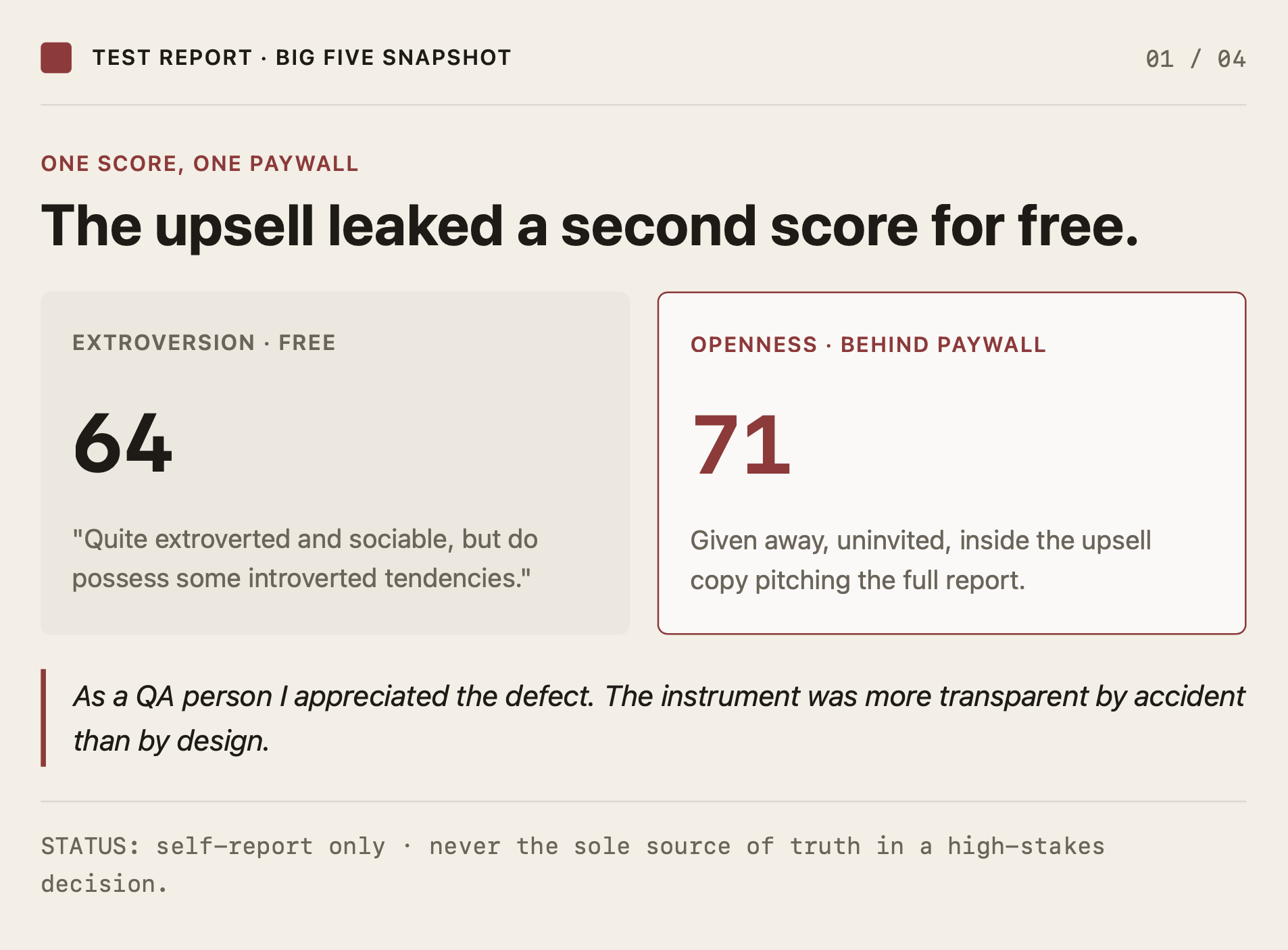
I didn’t — and not out of thrift. The previous fall I’d spent a full term in a psychometrics course learning how these instruments are actually built, and it left me with a rule I now hold firmly: self-report personality tests are wonderful for low-stakes introspection and conversation, and they should never be the sole source of truth in a high-stakes decision. So I took the free number and closed the tab — though not before noticing, with some professional amusement, that the upsell pitch itself leaked a second score to entice me: “you scored 71 on the Openness scale.” The paywall, negotiating with me, gave away merchandise for free. As a QA person I appreciated the defect. As a test-taker I appreciated the irony: the instrument was more transparent by accident than by design.
That was the safe part of the week. Then the reading found me.
The page that read me back
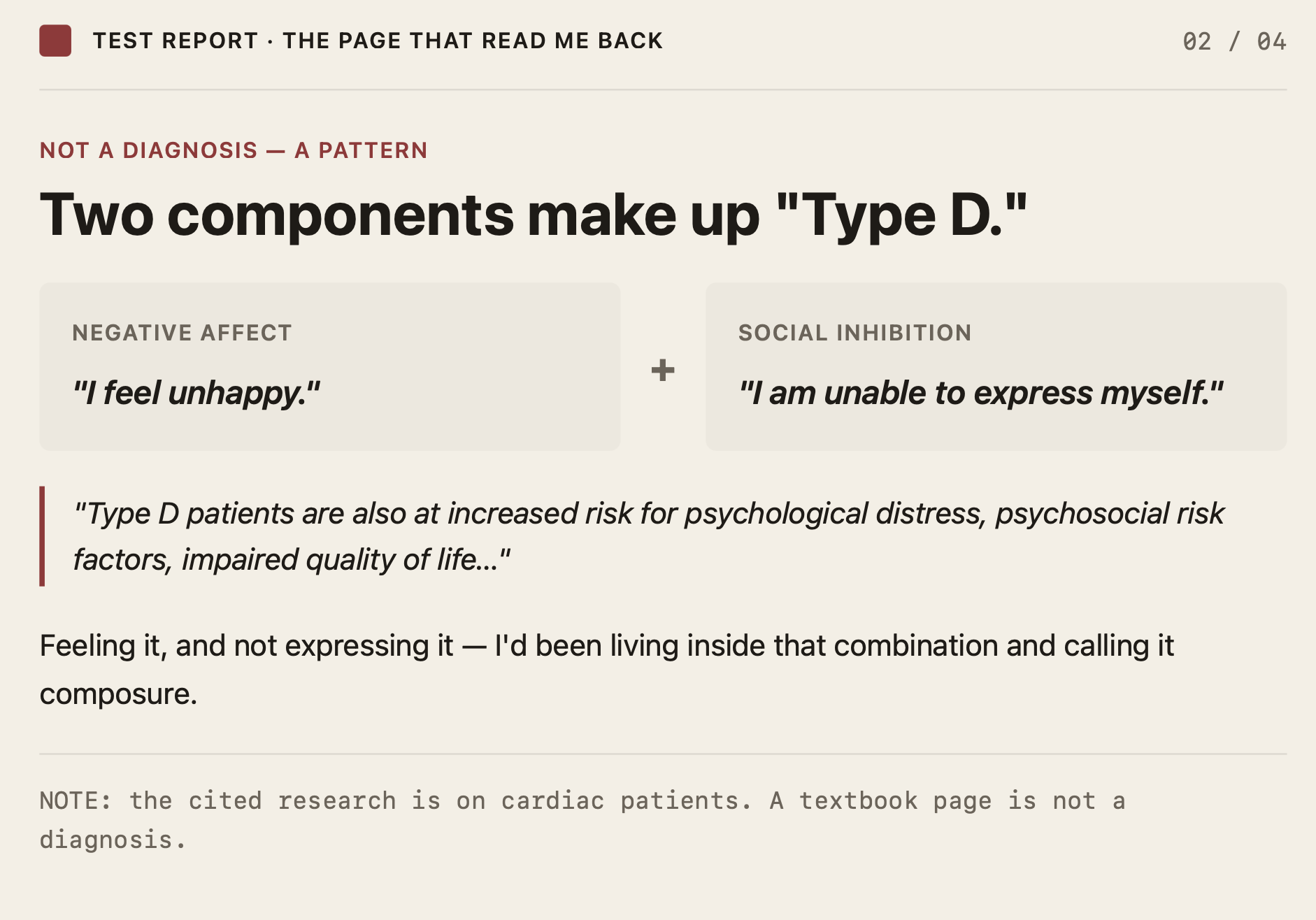
The same chapter covers what personality research says about health, and after the familiar Type A material it introduces the Type D — the “distressed” — personality: a combination of negative affect (“I feel unhappy”) and social inhibition (“I am unable to express myself”). Then it quotes a review of ten studies, and this is the sentence that stopped me:
“Type D patients are also at increased risk for psychological distress, psychosocial risk factors, impaired quality of life, and seem to benefit less from medical and invasive treatment.”
Let me be precise, because precision is the respect a claim like that deserves: that research is about cardiac patients, and a textbook page is not a diagnosis — nobody assessed me as Type D, and I’m not claiming the label. What happened was smaller and more personal than that. I read “negative affect plus social inhibition” — unhappiness you don’t express — and recognized, with unwelcome clarity, a season of my own working life. A role I’d once been excited about where the excitement had quietly decreased and my contribution with it, while I kept the surface professionally smooth. Feeling it, and not expressing it: that’s the combination, and I’d been living inside it and calling it composure.
I won’t overdramatize it. But I’d be dishonest to pretend I read that page like a student. I read it like someone being described — and the part about distress compounding, about patterns like this having real costs, was information I hadn’t wanted to price in. What I keep coming back to is a belief that predates the course: knowledge is hope. Naming a pattern is the first move toward changing it, and I’d rather know.
Where the same chapter gave me somewhere to stand
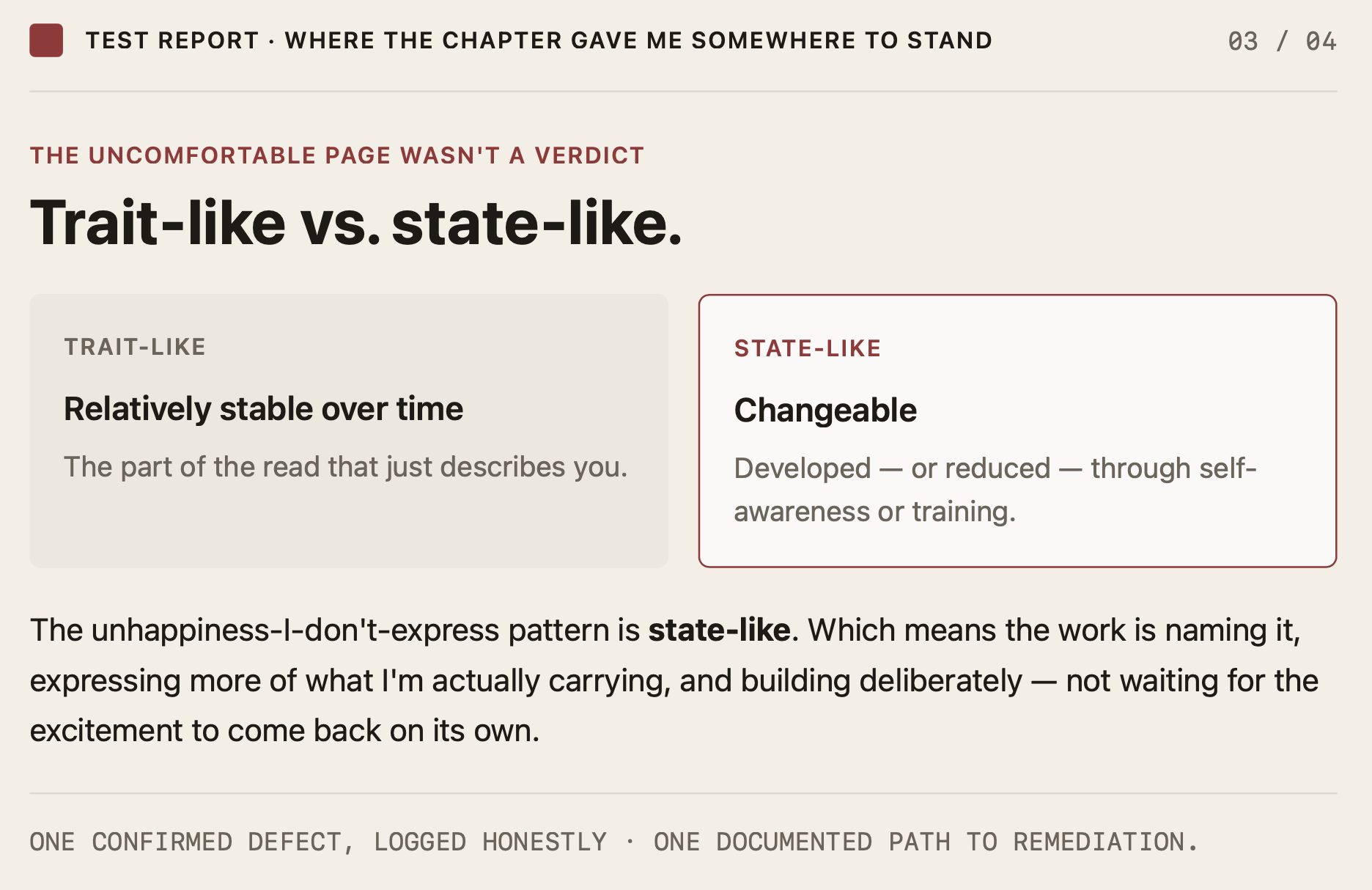
Here’s what kept the week from tipping into gloom: the rescue was on the very next pages. The chapter draws a distinction I’ve thought about constantly since — trait-like characteristics are relatively stable over time, but state-like ones are “relatively changeable, and a person can develop (or reduce) them through either self-awareness or training.”
The state-like idea has a name and a framework: Psychological Capital — PsyCap — Fred Luthans’s four-part construct of efficacy, hope, resilience, and optimism. The research the chapter cites says PsyCap is positively related to employee empowerment and engagement, and improves proficiency, adaptivity, and proactivity at work — and, crucially, that it’s developable, through exactly the kind of deliberate attention I was already giving the problem by writing about it. The line that landed hardest: PsyCap is more than “what you know” or “who you know” — “it is focused on ‘who you are’ and ‘who you are becoming.’”
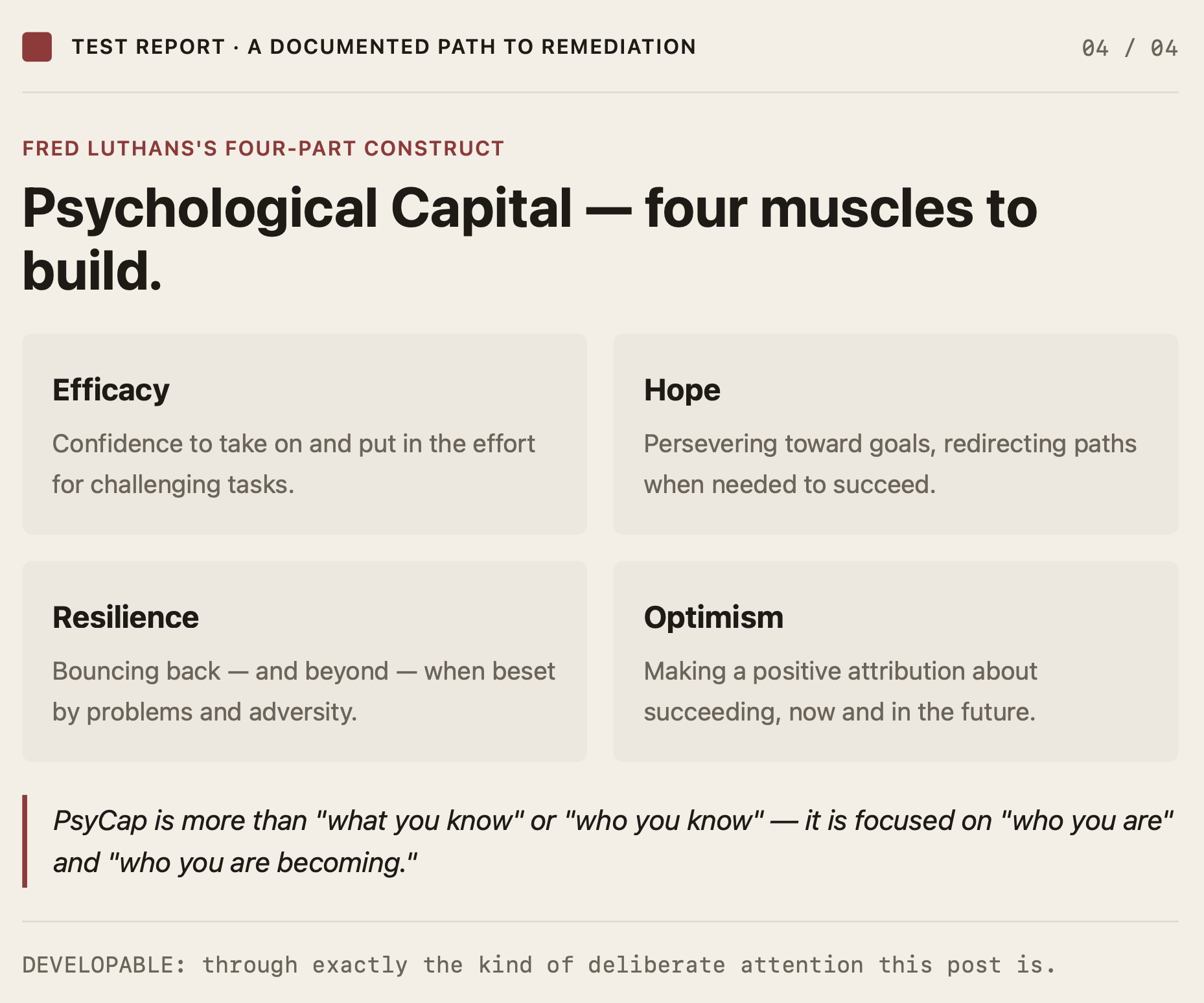
That reframed the whole week. The uncomfortable page wasn’t a verdict; the hopeful pages weren’t consolation. Together they were a test report: one confirmed defect, logged honestly, and a documented path to remediation. The unhappiness-I-don’t-express pattern is real and it is state-like — which means the work is naming it (this post is part of that), expressing more of what I’m actually carrying, and building the four PsyCap muscles on purpose rather than waiting for the excitement to come back by itself.
Why I published this one
My whole project on this site is posting test reports on myself — the showcase paired with the honest audit. This is the audit with the least showcase in it, which is why it nearly stayed in the drawer. But an audit that only publishes its passes is marketing, and clarity that’s only comfortable is just branding. A textbook found me on a page I didn’t expect. Being found, I’ve decided, is the beginning of the work, not the end of it.
Thanks for reading. A question I mean gently, for anyone who’s ever been read accurately by an instrument, a book, or a person: what did the accurate version say that you’ve been quietly not looking at — and which part of it is changeable enough to start on?
A note: this piece touches on burnout and wellbeing. If any of it lands close to home, it’s worth talking to someone you trust or a professional — and I’m glad you read this far.
Comments