From Needs Assessment to Recommendation: The Belonging Fund Project
📍 Power and Privilege in Systems 📅 July 14, 2026 · 8 min read
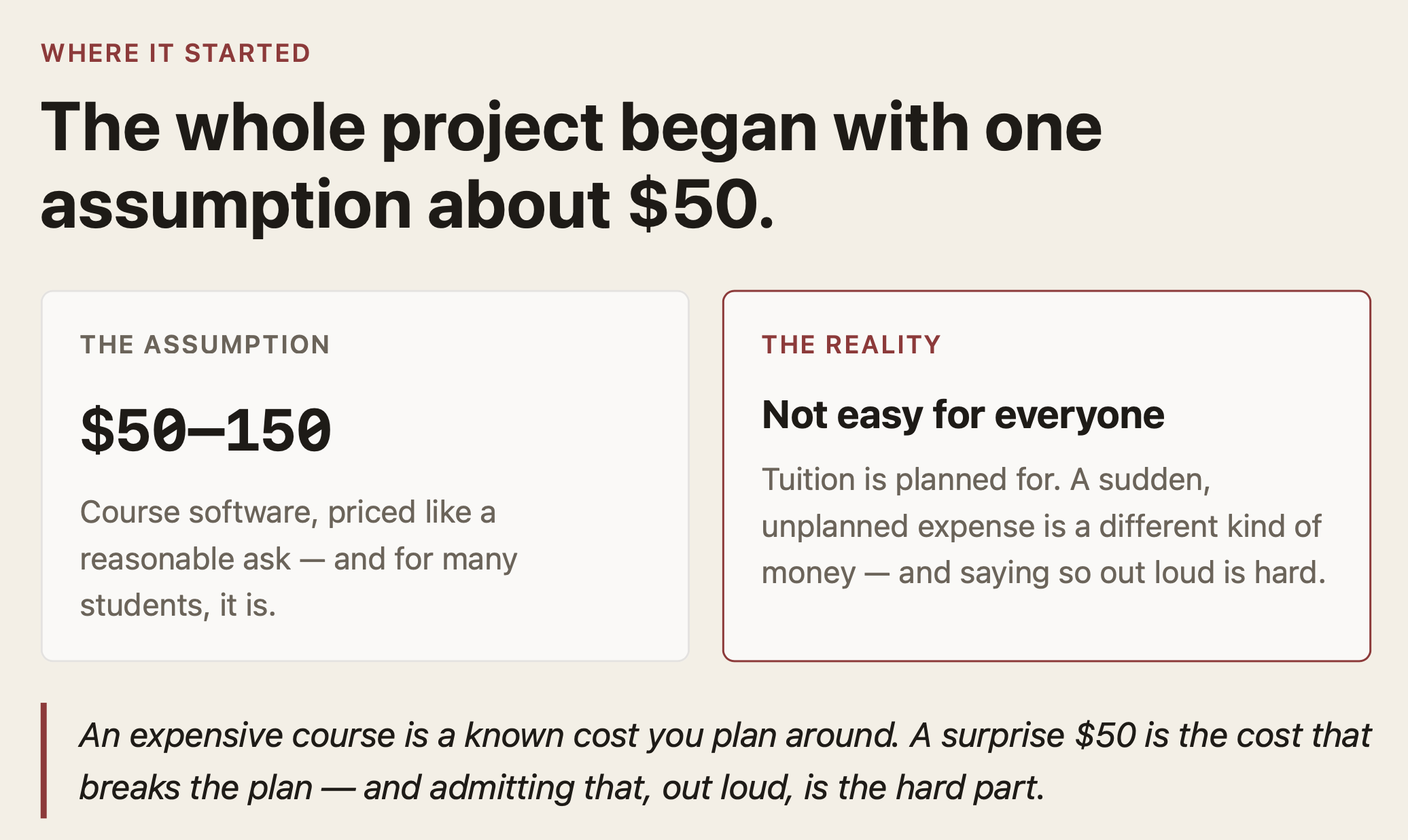
My team designed a fund to help students feel they belonged. Our biggest limitation was that we never spoke to a single student.
This was a real client project, not a hypothetical case. A graduate course paired my team with a university that wanted to build an emergency fund for students in financial crisis, and asked us to hand back something they could actually launch.
There’s a particular dread in having to ask an institution for money when you’re already in trouble: you wait until it’s bad enough to justify asking, you rehearse how you’ll explain yourself, and you brace for the small humiliations of proving you qualify. My team spent a semester designing that exact moment for other people.
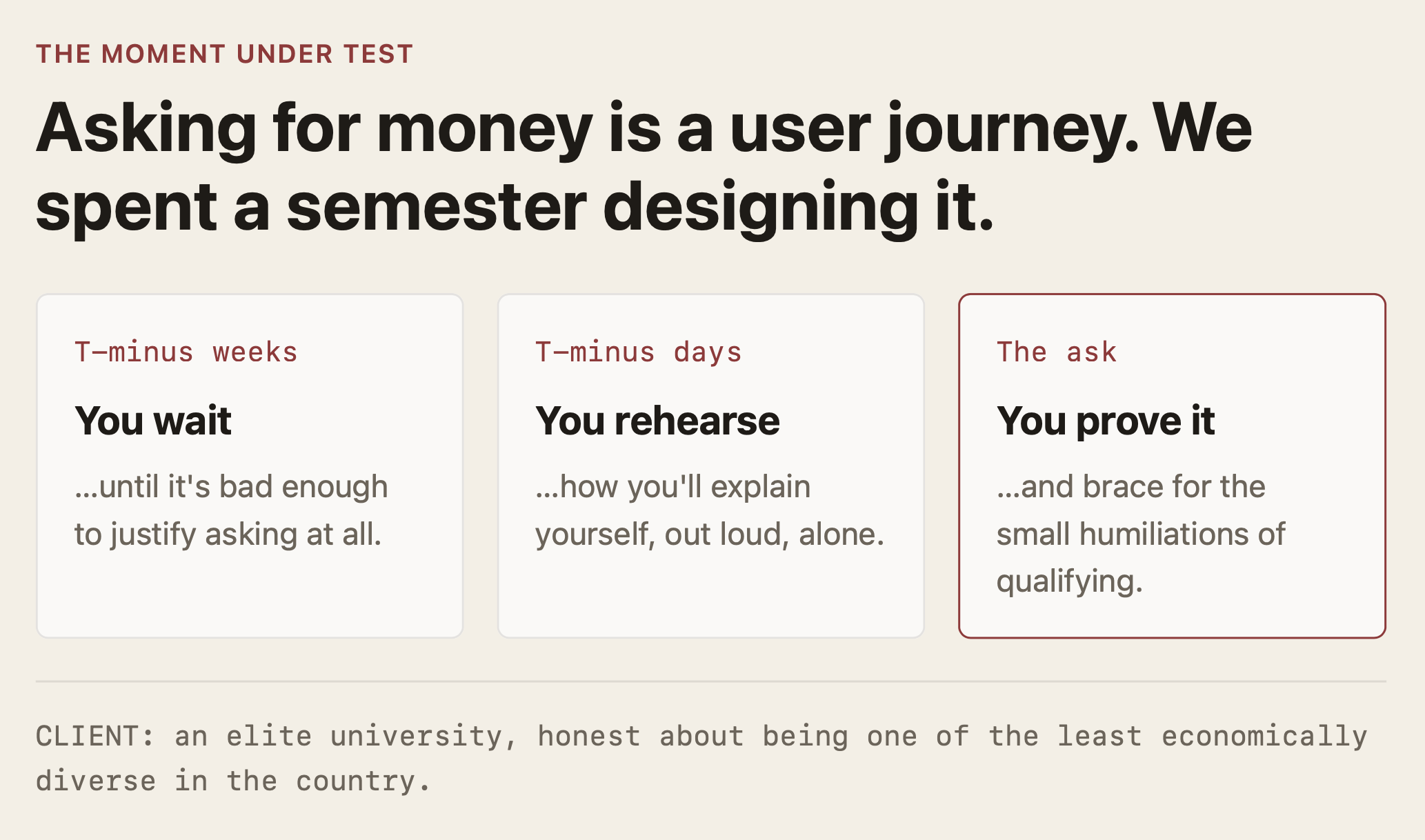
The brief opened with a fact the client was willing to say out loud about itself: it was one of the least economically diverse elite universities in the country, and it wanted help making financial need less shameful to admit. That honesty set the tone. This was never going to be a feel-good report; we were there to design how a student in a hard month would ask for money, and how the institution would answer.
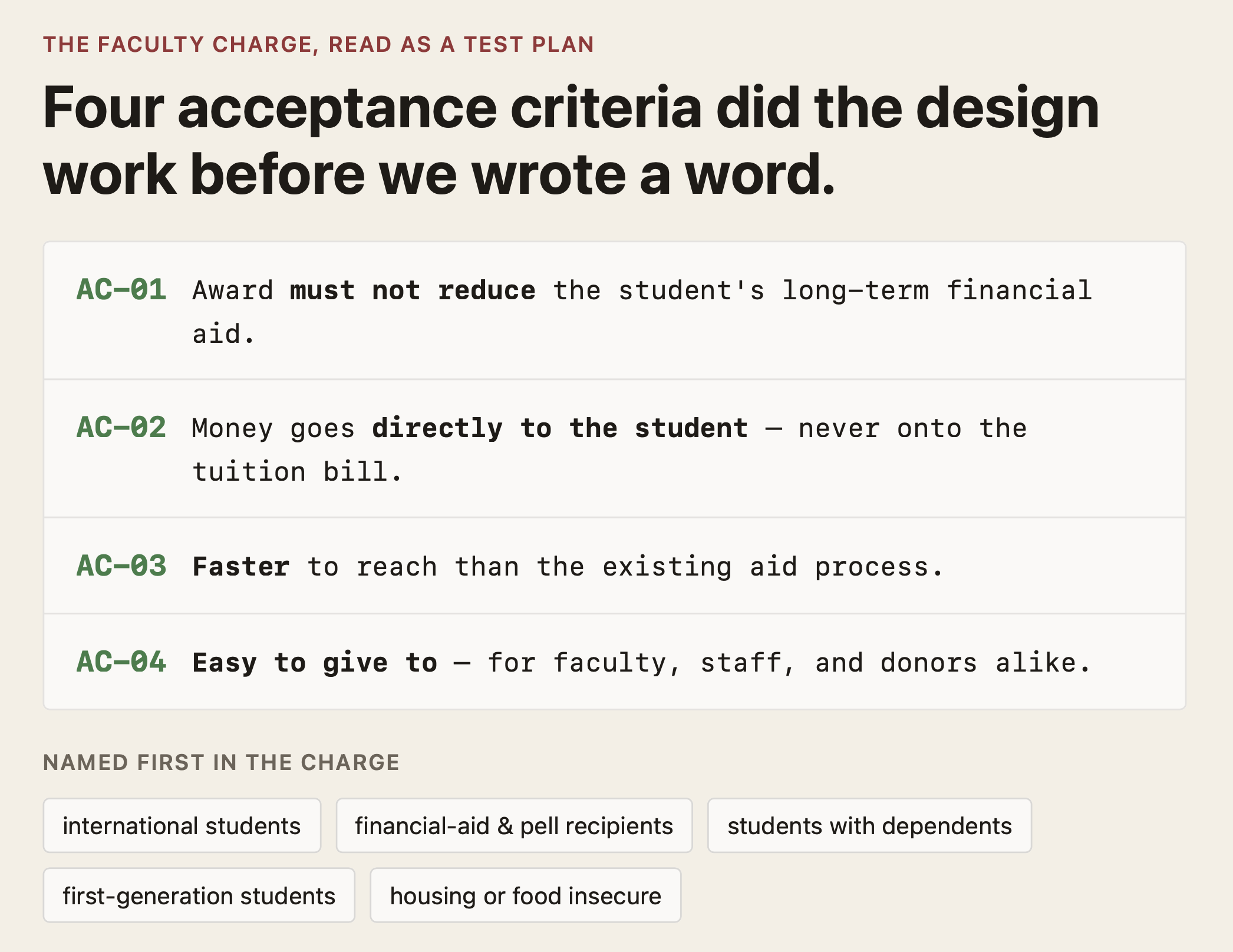
Four of us took it on. The faculty leads gave us a charge with unusually sharp constraints:
Complete a leadership and literature review, research similar funds at peer schools, and create a program model the school can implement next spring. The award cannot reduce a student’s long-term financial aid. It must go directly to the student rather than onto their tuition bill. It must be faster to reach than the existing aid process, and it must be easy for faculty, staff, and donors to contribute to.
They also named the students they most wanted the fund to serve: international students, financial-aid and Pell recipients, students with dependents, first-generation students, and those facing housing or food insecurity. Those constraints did most of the design work for us before we wrote a word.
How we worked
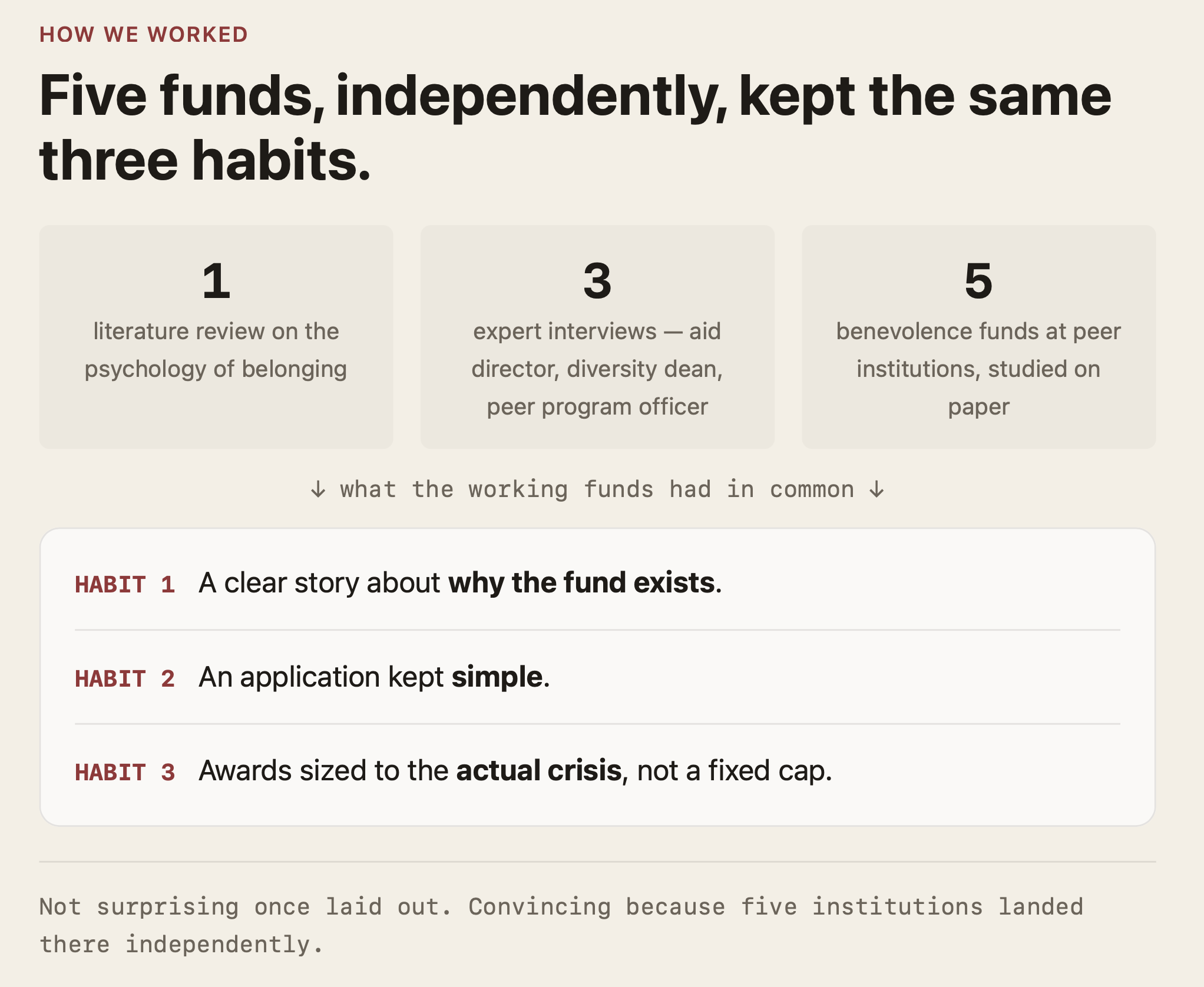
We ran a literature review on the psychology of belonging, some of it from higher education and some from workplaces. We interviewed the school’s director of financial aid, its first associate dean for diversity work, and a program officer at a peer university whose fund had lasted long enough to teach us something. Then we studied benevolence funds at a handful of other institutions to see how they set eligibility, moved money, and capped awards.
The funds that worked shared a short list of habits: each told a clear story about why it existed, kept its application simple, and sized awards to the actual crisis rather than a fixed cap. None of that was surprising once we saw it laid out, but watching five institutions independently land on the same handful of practices is what gave us the confidence to recommend them.
The limitation I can’t stop thinking about
Here is the part of the report I insisted we state plainly. We designed a fund meant to strengthen students’ sense of belonging, and we never interviewed a student. Not one.
The demographic data we were handed covered graduate students only, so our recommendations honestly could not speak for the undergraduate experience at all. We reached out to every peer fund on our list and only managed a real conversation with one of them. So we were building a model of student dignity from interviews with administrators and a stack of program webpages, which is a strange way to design something whose whole purpose is how a struggling person feels when they ask for help.
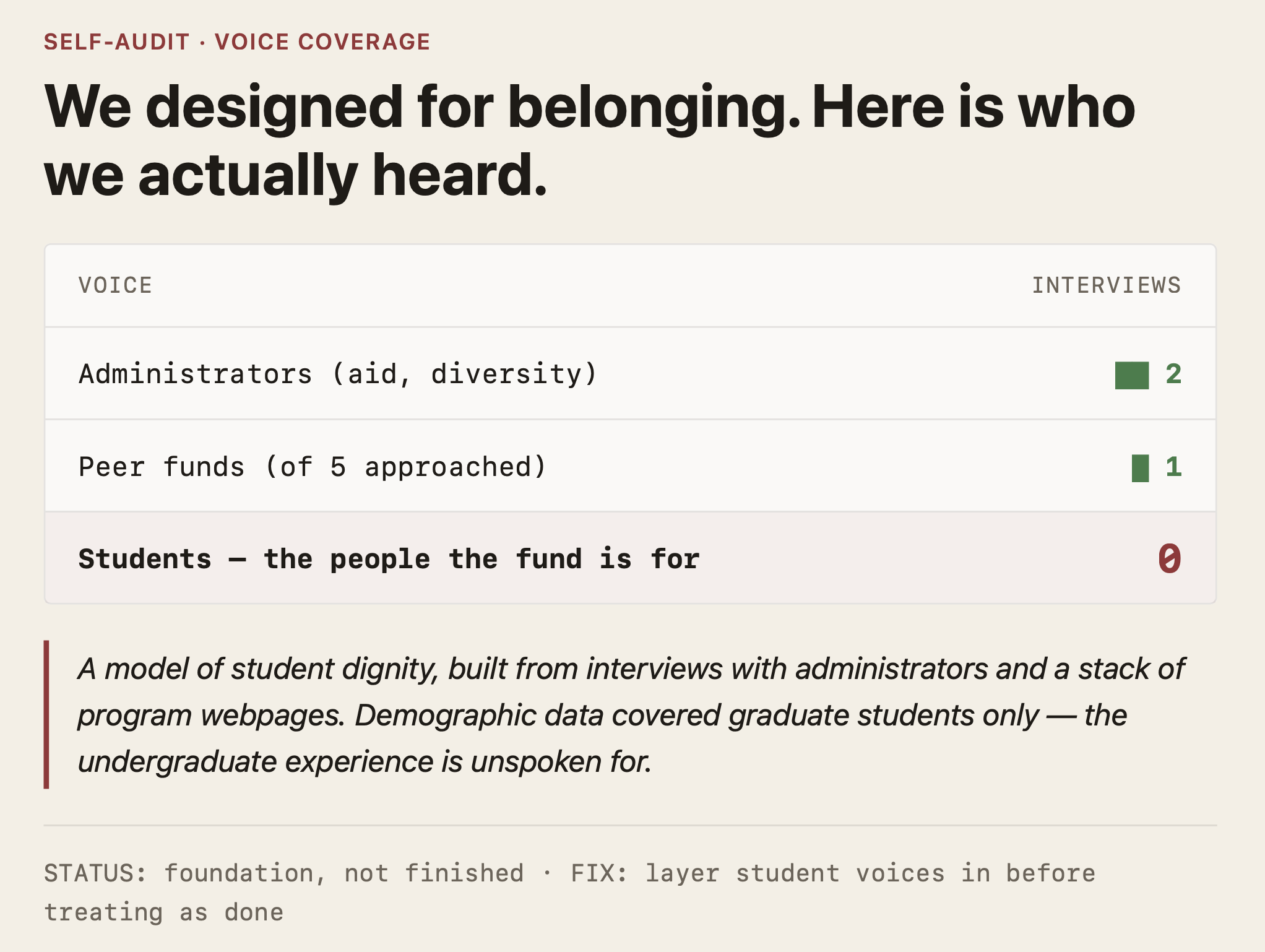
I don’t think that invalidates the work. It does mean the recommendations are a starting foundation that needs student voices layered in before anyone treats them as finished. Writing that limitation down felt more useful than pretending we had covered ground we hadn’t.
The recommendations I owned
My section of the deliverable was the recommendations, so this is the part I’ll answer for.
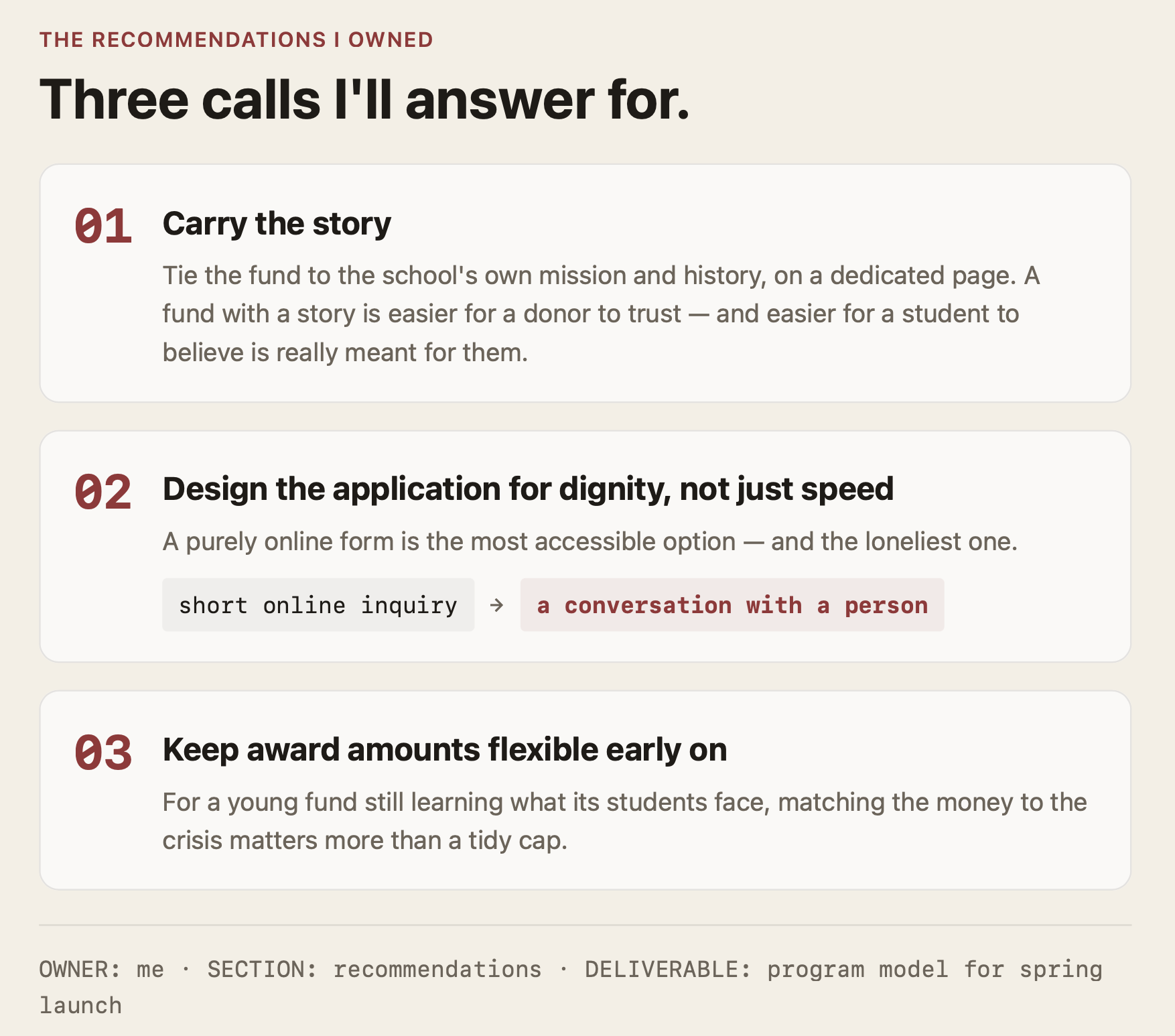
- Carry the story. When the fund launches, connect it to the school’s own mission and history, ideally on a dedicated page. A fund with a story behind it is easier for a donor to trust and easier for a student to believe is really meant for them.
- Design the application for dignity, not just speed. A purely online form is the most accessible option and also the loneliest one. I recommended a short online inquiry followed by an in-person conversation with someone on the fund committee. Talking through your situation with another human being lets a student explain the hard, particular details with discretion, and it keeps the exchange from feeling like begging a machine.
- Keep award amounts flexible early on. Some schools set a hard cap; others size the award to the severity of the need. For a young fund still learning what its students actually face, matching the money to the crisis matters more than a tidy rule.
Why this project fits my work
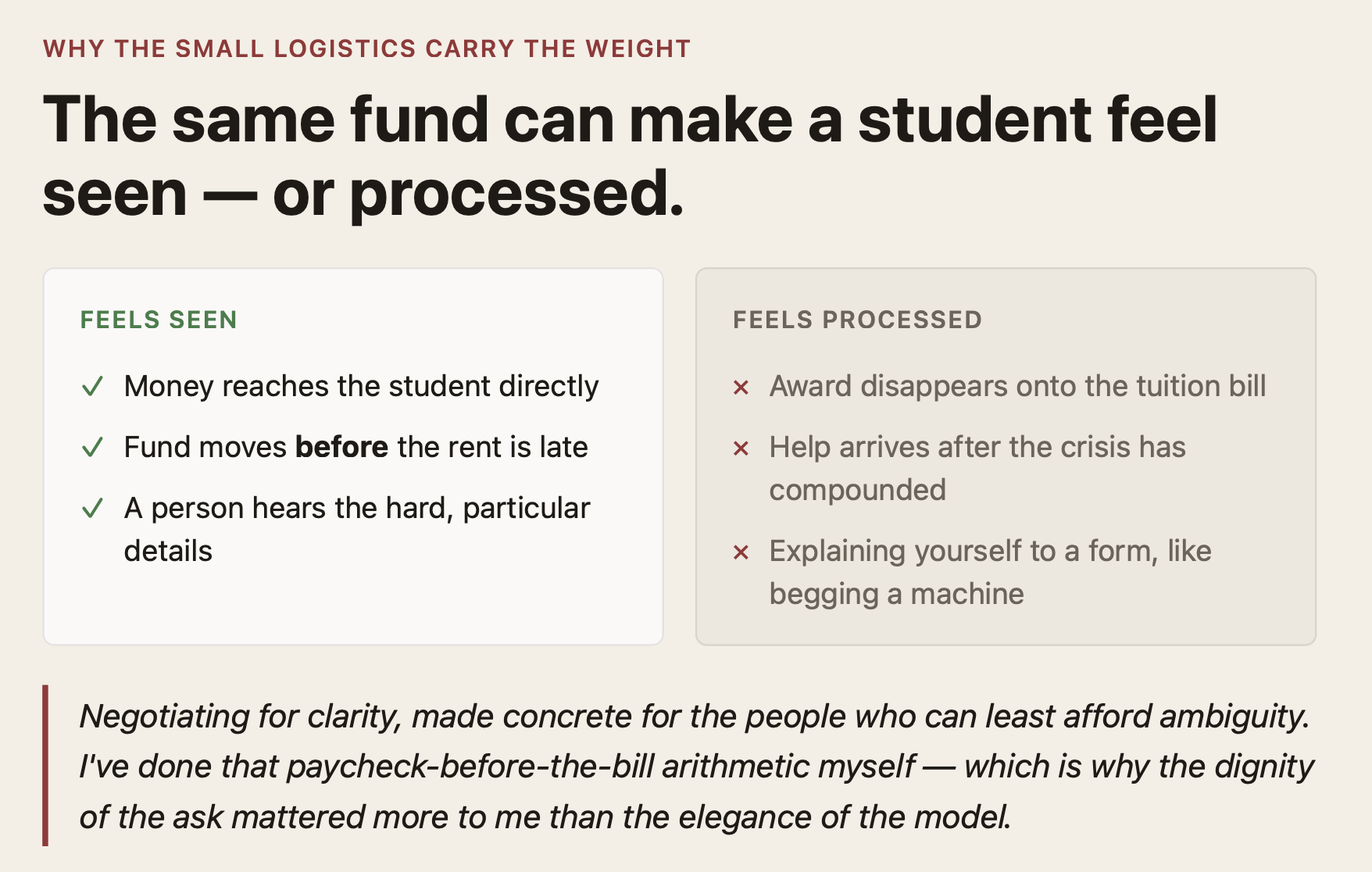
My throughline is negotiating for clarity, and a belonging fund is that idea made concrete for the people who can least afford ambiguity. The details that look like small logistics carry the whole weight of it: whether the money reaches the student directly or disappears onto a tuition bill, whether the fund can move before the rent is already late. Get those wrong and a program built to make people feel seen will quietly make them feel processed instead. I’ve done my own version of that arithmetic — counting whether a paycheck would clear before a bill came due, more than once, in more than one country — which is why the dignity of the ask mattered to me more than the elegance of the model.
Getting the affected people into the room is the first thing I’d change if this project came around again.
Thanks for reading. If you have ever helped build a program meant to support a group you weren’t part of, I’d like to hear how you handled that gap: did you find a way to get the affected people into the room — and what changed in your recommendations once you did?
Comments